
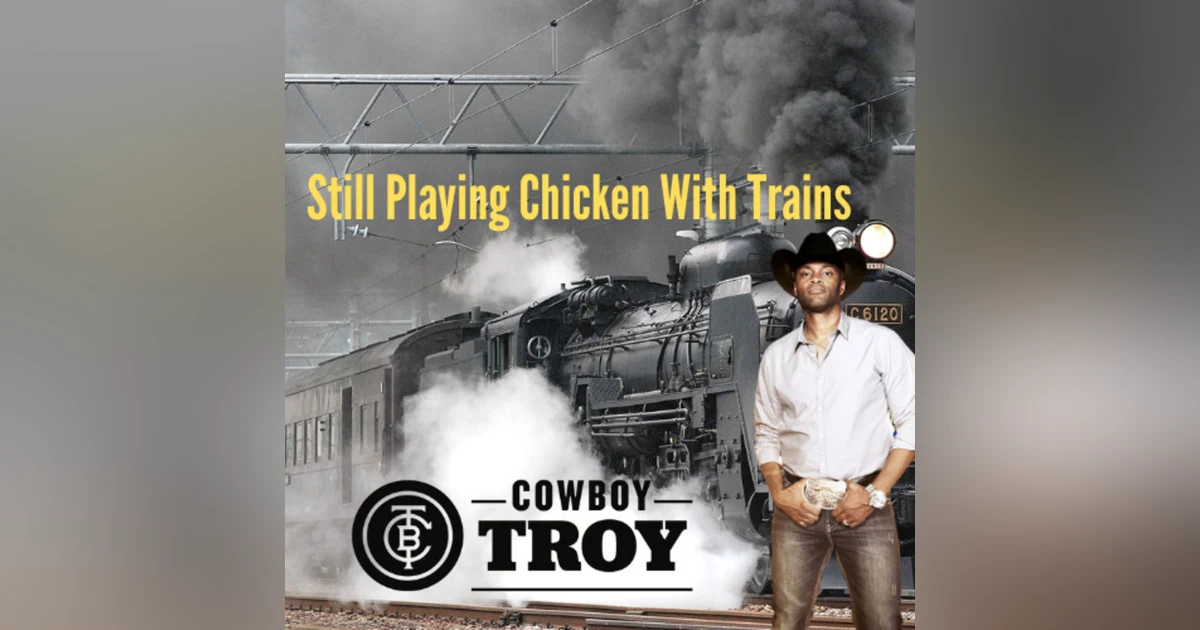
Cowboy Troy - Still Playing Chicken With Trains

 Apple Podcasts
 Spotify
 Castro
 RSS Feed
 Cowboy Troy took his idea of mixing Rap music with Country music and created a new genre of great music. Visiting with The Trout, Cowboy Troy details how he came up with the idea that set his new music career on fire. He talks about how his relationship with Country Music star, John Rich and how Rich of Big and Rich fame helped ignite his career. It's an intriguing story about a guy who goes from shoe store salesman to national musical fame. Watch this exclusive interview with Cowboy Troy and The Trout.
https://cowboytroy.com/
https://www.thetroutshow.com/
Thanks for listening for more information or to listen to other podcasts or watch YouTube videos click on this link >
https://thetroutshow.com/

Season 03 - Episode 13 – Cowboy Troy | Transcription
Sponsored By:Today's podcast is supported by David Smith of Edward Jones. Are you happy with your financial strategy, or maybe like to see what other opportunities are out there? Give, David, a call at 469-372-1587. That's 469-372-1587. David is only concerned about one person that you and your financial health. So check him out. David Smith, Edward Jones 469-372-1587.
PODCAST INTRO (Trout): Hey guys, it’s Trout. I hope you're having a great day. What do you think about if you were working in a shoe store, in an athletic shoe store, and you've always wanted to be a musician and try it out in different places, through some music out to people? And then one day, you get a phone call from a record label, and the person on the other end says, “We want you to record for our record label.” And you're like, “What?” That's the story of my guest today. Well, part of the story, and that is with Cowboy Troy. This is a guy that took an idea, taking rap music and putting it with country music that nobody ever thought of before. And that's exactly what he did. And he made his hit happen with that in the help of some great friends. And he's going to talk about his friends that helped him get where he is now. A guy that people know is Cowboy Troy that still makes great music and “Yes, he's still playing chicken with trains?” Absolutely. So up next, the guy that he still plays chicken with trains, Cowboy Troy and his story. That's next on The Trout Show.
[Music 00:01:47 – 00:02:52]
Trout: Tell me a little bit about what it was like, though, at that time. And how you got started with your basic? You obviously grew up in Victoria.
Cowboy Troy: Well, I was born there.
Trout: Oh, you were born in there. So where did you go from there?
Cowboy Troy: So I was born there. And then six months after I was born, my folks moved back north. And they had gone to college at East Texas State University.
Trout: Which is where? Where's that?
Cowboy Troy: It's in Commerce, Texas. It's now known as “Texas A&M Commerce”. It was still East Texas State University. My parents met in college. They dated for about a year. And then after that, they got married. And then after that I was born. And six months after I was born, they moved back up to that area of the North Texas and East Texas State, which is about 60 miles to the East of Dallas. And then my dad finished grad school. My mom finished her undergrad. And from there, we wound up over in Fort Worth. And so we wound up in Fort Worth probably I guess, I was told in 1972 and lived there for a while and live there before we moved to Dallas in 1984.
Trout: Excuse me. So both your parents were professionals. They both went to school and did they go on to get professional jobs, they use their degrees?
Cowboy Troy: For a while, my dad got his undergrad in music. And he taught music for a short period of time and then he went back and got his Master's in Counseling Psychology. So he kind of move a music into a professional area. And mom back in those days, she got her degree in Home Economics and then from there, she eventually in the 80s wound up getting a master's in HR or something like that if I recall. So eventually they wind up with professional degrees outside of what they would have normally preferred.
Trout: So when you're growing up, so where did you spend most your time at Fort Worth?
Cowboy Troy: So 11 years of Fort Worth until 1984. And then we moved in 1983 or 1984 moved to Dallas. And then from there, I went to school in Austin after I graduated high school. And then after I graduated from University of Texas, I moved back to Dallas. So the majority of my time, all told, I spent 15 years in Dallas, 11 in Fort Worth for an Austin, and then the 13 years in Nashville, and then now I'm back in East Texas, and been back here six years now.
Trout: Here's a guy that you get your degree and then what’s your degree in that? What is your degree in?
Cowboy Troy: Psychology. And then I got a master's in Business Administration, I got an MBA in marketing. So we got that in 2017.
Trout: So when you started, and you get your degree, what did you want to do? What do you think you wanted to do when you were growing up?
Cowboy Troy: As a kid, I thought about being an engineer. And then I realized that even though I liked math, there was more math involved in engineering that I probably was skilled for. So I kind of changed my mind on that. And, eventually, I got to the point where I thought, it'd be kind of cool to be an economist, because economics and things like that, that would be cool deal. And then after I changed my mind on all that, I found myself in the music business and all these years later, I thought, it'd be kind of good, because at one period “The music business is a cyclical kind of a thing.” And you have ups and your downs. And then during one of the down periods, I was thinking, “Man, it's kind of kind of slow. Maybe I might want to look into finding a corporate job or professional job.”
Trout: Sure.
Cowboy Troy: And this was maybe 10 years ago, and I was like, “Man, it's rough. I better start doing something.” And so as I'm looking around, they're like, “Well, you've got experience, but you have to have a minimum of a master's degree to be considered eligible to apply for that.” I started looking around, so I went back and got an MBA. And as I got my MBA, I graduated with that. And then next thing, the music business picks up again for me, and so we're back on an incline. And using the marketing, it helped me to understand how to better market not only my music merchandising, because as a music, as an artist, the majority of what you're going to earn is through merchandising. Music is your calling card. Music tells you have something fresh, something new, or reminds them of something that they had a great time with. And it allows the booking agent to use your music as a marketing tool. Because usually when you go in your booking and it's trying to get you some shows are like, “Does he have anything current?” Well, “Sure, you just released X, Y, Z, or whatever the songs are, whatever the album is,” and that comes in, “Cool. It's good to know that he's still doing music or got something fresh.” And from there, you get people in the door. And once you get people in the door, then you have to have merch that is going to get excited about walking around. And I had a great time of the show, I'm gonna get a t-shirt or a cat or at the very least a beer koozie or something to remind me of the night and also your merchant is your secondary marketing tool. Not everybody's going to listen to your songs, but they may understand the fact that “Hey, I really enjoy hanging out at the show.” And after the show, we can shook hands, took pictures and autographs, whatever it is serves as a marketing tool. Your name is your brand and your persona, your attitude and the way people interact with you becomes a way for them to understand, you know what, “He's an okay dude, I may not know all of his songs, but he hung out with us.” And I tell people, I tell younger artists sometimes it's like, “Man, people may not remember the songs you sang or even the songs you help other people write.” But they will remember whether or not you hung out after the show and had a beer with them and shook hands and took pictures and all that kind of stuff. So you do have to do multiple things when you're out on the road. And I've told people before it ain't called “Show Friends”, it's called “Show Business”. You have to make sure that you understand the different things that are involved. Because at the end of the day, the record labels, the management companies, the booking agents, they like what you do. But they also want to make sure that you're generating revenue. And record label is funding your efforts musically, they would like to see a return on their investment. So you figure out ways of understanding what they're expecting, and how to help them achieve those goals, because they're helping you achieve your goals by getting out in front of 100s of 1000s of people. And in order to do that, you have to do more than just say, “Hey, man, just point me to the stage, where do I put my microphone up, where I'm putting my guitar, where are the drums all that stuff?” It's more than just coming to the stage? Yes, it's about art. And that is the root of all of it. Because without the art, there is no product for people to generate revenue from. But as a musician, as an artist, you have to understand that, and also know how to make sure that you are trying to make sure that you are helping to market yourself in such a way that people can find your art, can consume your art in the way that they choose to. I mean, people talk about, and as you mentioned earlier it used to be CDs, now it's all digital. And it's really interesting how people consume their music. My final project for marketing research was helping to understand how country music fans consume their music. And I ran surveys and all that stuff that I put together, try to figure out, and a lot of people consume their music digitally. And I think the numbers were only 37%, or something like that, at that time, really only preferred physical copies, everybody else consumed their music through digital means streaming television, or radio, or something like that, that did not require a physical copy of the music. And I don't know how much about pop music, but I gotta buddy.
Trout: I do.
Cowboy Troy: So I've got a buddy named Charlie Bonacci. His stage name is Charlie Steele. And he was the lead singer for the pop band “Lanier” back in the 90s. And they sold records worldwide. And I remember talking to Charlie, because Charlie had at one point come on, and helped work on managing my career and the career of other folks that I know. So, Charlie, was telling me one afternoon, and we were out on the road, I forget where we were. But Charlie says, “Dude, one of these days, you're gonna be able to go out there and say, here's my brand new song, go out and download it now.” And people can download it. I'm like, this is like, 15 years ago and I'm not sure. Trust me. They're doing it now. They're working on it now. And sure enough, people are downloading phones, downloading songs to their phone, you can go out and say, “Hey, this is my brand new saw brand new album.” And people from that point, you can just take a little minute like the band Vamp a little bit, and then the people are downloading this song right while you're about to play it. And it's one of those things. And he was telling me about that a long time ago. And then sure enough, there it was. So I'm like, “You know what, I think it's a good idea to be on the front end of this, instead of being on the back end, I think with the whole Napster and how that started out early on in the early 2000s.” And everyone was freaking out, “Man, it's tearing up everything.” But you know what, at the end of the day, that's what's happening. And if you still want to have a career in music, you got to figure out how to get in front of it.
Trout: I remember when you two was one of the first bands that talked about, and I can't remember what it's called. But if you went to their concert, only you in the concert could download the song has something to do some area in that concert, and I remember them getting up. I wasn't there. I just remember reading about. Here's one of our songs, our new songs are for new album. You can download it right now. And that's been a few years ago. And I thought, “Well, that's just such a cool thing to do.” Because then then they leave they have a copy of it. Now I'm sure that people in the business you go, you're losing that revenue you're gaining. I mean, you might be losing those. But at the end of the day, you're actually gained because you give them something personal right then. Where were you working, or what were you doing when you said I want to get into doing Cowboy Troy?
Cowboy Troy: Well, I got the nickname Cowboy Troy in college, and just stuck. And I was DJ in frat parties, or going out to clubs, and I jump up and perform with whoever was DJ’ing at the time, stuff like that. And so I was just kind of cutting my teeth in those days. And then eventually it got to the point where I'd sit down with buddies and I'd be like, “Man, we are going to cool if we did a rap record or couple of rap songs but use country instruments.” And they're like, “I don't know, it makes sense.” Trust me. So then it got to the point where, in 2001, I put out a three song EP, called Hip Hop hysteria. And Hip Hop hysteria, I printed up a bunch of copies. I mean, it's gonna be great, and blah, blah, blah, blah, blah, it's gonna be the thing. And now people are using those CDs as beer coasters or something.
Trout: If they still have them.
Cowboy Troy: You know using them as medallions wear gold chain. I only have a few copies left, but it's crazy how it worked. And then eventually people started understanding that, that's kind of an interesting thing. But is it really something that's going to move the needle, I was like, man, I've been spending plenty of time in country bars. And since the early, early 90s. And one thing I remember is that during the first 45 minutes of the hour, the DJ or the band that's playing plays your traditional top 40 country songs. And then after that last 15 minutes to the hour, they're mixing it up with rock, rap or dance music and that's it. Every time the rap songs come on, the dance floor was completely crowded, packed, all the cowboy hats running around the cowgirls are out there, , doing their dance, and only it's gonna work.
Trout: No two step in there.
Cowboy Troy: No, no, no. And I was like, “We'll see that.” And they're like okay. And then all these years later you were right. And look at, “Well, I tried to see the trend before, it becomes something,” and I was like, “Well, how can we figure that, and move that into an area that it's going to be fun, and a way to do something it's original, and also had the opportunity to get a group of listeners into something that they had not had an opportunity to really get into before?” So that's how it worked out.
Trout: When you recorded the first off, did you have people that played on it? Or, did you call friends to perform, or what did you do?
Cowboy Troy: I have friends that played instruments for it. And I didn't have any kind of phone list of people to call.
Trout: But we all have acquaintances that we can call and say, “Hey, do you want to do this and do that?”
Cowboy Troy: Everybody's played on it back then.
Trout: When did the big break happen? And I always want to ask these questions, because you had the big song. When you know, when was that moment? First, tell me how it came about. But when was that moment, you knew that, this is gonna be big. Had that all come about?
Cowboy Troy: So I met John Rich in 1993, summer of 1993. And he was playing in a band. Back then they were called “Texas See”. Because all the guys in the band, we're from Texas, but they met in Tennessee. They got a record deal and they became known as lone star. So I met John in 1990. And he and I became friends. I was hanging out in a bar he was playing in.
Trout: Was at Nashville or is that in Texas?
Cowboy Troy: That was in Dallas. I met him somewhere. And I agree in Dallas that always called barred money. And, John, and I became friends, because we had similar interests. And he started asking me, “Well, what's going on? What are you up to?” And I told him about the music. I was doing what I'm working. He got the country rap and hip hop, whole thing. And he put it together and like, “What?” and we stayed friends. And then in 1999, one of my first trips to Nashville, he introduced me to Ben Kenny, and he had met Ben Kenny there at that time, and they were working on stuff, writing songs. And I met Ben Kenny became friends with Ben Kinney in 1999. So all these years later, they started doing these things called “Music Mafia” musically artistic friends and alliances. And everybody was just kind of there hanging out and serving as sounding boards for all the other artists that were involved in. They met for like 72 Tuesday's in a row.
Trout: Wow.
Cowboy Troy: Every week, it started out at the pub of love. And every week there was always, people were just getting up jam and serving as a sounding board that sounds cool. Let's work on something here, change this. But it was kind of a fun thing.
Trout: I think that'd be fun.
Cowboy Troy: Other people started showing up. Then eventually, it started making enough noise that people from record labels started showing up. Gretchen Wilson got signed out of “Music Mafia”, she got signed to Sony, big and rich got signed to Warner Brothers.
Trout: People were coming to the place and listening to it.
Cowboy Troy: They started hanging out. “Big & Rich” got signed by Warner Brothers. I got signed, because “Big & Rich” called me up after they got signed, and they were like, “Hey, man, we're gonna do this song or album, we want you to come and rap line.” So they brought me to Nashville. I recorded my verse on the song, and then I went back. And the song is called “Rollin' (The Ballad of Big & Rich).”
Trout: You met “Big & Rich” and they'd asked you to do this one song, the one song you're talking about, but we hadn't gotten to the train song in.
Cowboy Troy: Correct. So when Rollin was recorded in 2003, and then eventually, it made the album. Their first album was called “Course of a different color”. And it's one of the most ingenious collaborations and collective of songs that you could think of it is such a wide variety and a wide range of songs on that album is really cool. I was working at footlocker at the time. And I was on my lunch break, and I see that I had a missed call and a message from John. So I hit the recording, I'm sitting in my car on my lunch break, because you're not allowed to have your phone number on the sales floor. I'm sitting in my car on my lunch break. And I hear this voice is like, “Troy, this is your future speak calling.” So John proceeds to tell me that they're going out on tour with Tim McGraw. So I call him back immediately. And they're in the car. They're going somewhere. And I'm like, “Man, it's so cool. Congratulations. I'm happy for you guys. It's awesome. And I can't wait to get to Dallas. Man, it'd be cool to get a chance to come see the show.” Now you don't understand we want you to go on the road with us. I'm like looking at my phone. And I'm looking around like is a serious.
Sponsor:Concerned about your financial health and reach out to David Smith of Edward Jones 469-372-1587. That’s 469-372-1587. You can conduct business where you are. Get your financial health check up with David Smith of Edward Jones, his number one concern is you. That's David Smith of Edward Jones 469-372-1587.
Cowboy Troy: Man, you don't know whether start yelling or start crying, because it's such a cool thing. I'm excited about it. And I was happy for my friends. Like, now we want you to go with us. And working as a shoe salesman. You're not making a lot of dough. Thank you, man. This is a whole different deal. I mean, I've been working to get to this point, and then I get the opportunity. So I was like, “Okay”, next thing, I'm out on the road got “Big & Rich” and it was gonna be just Summer Tour. I'm like artists cool and I was gonna go back to my job. The people at footlocker said you can come back, we'll hold your spot far from getting my own store. I was an assistant store manager.
Trout: You're gonna get your own store. That's what you're working to?
Cowboy Troy: I get my own store. And they're like, “Well, hold your spot.” And when the summer's over, it's like, “Cool. Here we go.” Well, summer turns into an invitation to the fall tour as well. On the fall tour with McGraw. We'd have doing like 80 shows with Tim McGraw. What year in 2000. And one day I'm like, call my store manager and say, “Hey, man, what's going on?” He said, “When you come in back, because this was November or something like that.” I was like, “Hey, man, I just wanted to call and let you know I was calling you for. I just got an offer for a record deal. I just got an offer to go and record with Warner Brothers.” He’s like, “Really?” Again, “Well, congratulations, man. You're a great employee, blah, blah, blah”. And then in 2000, so in November of 2004, we start recording the start of locomotive which was my first major label out. I said, it was two words loco motive. And I said because I had crazy intentions with combining rap lyrics and country instrumentation and calling it hip hop and went so far as to trademark, the name hip hop and like, this is makes no sense. And before I got the deal, the folks in Warner Nashville, we're talking to the folks at Warner in LA, we got this guy, I think you should hear him blah, blah, blah. It's gonna be a big deal. And one day we were out on the road and we were in Arkansas at Arkansas State University. New basketball gym, their basketball arena. And we were opening from McGraw at night. And the head of Warner LA just be there, it happen to be there. Just to see how crazy the crowd was going to respond.
Trout: And for those people who don't know where Arkansas State is, you just have to look it up. You're gonna have to be there.
Cowboy Troy: It was crazy. So I remember the tour manager “Hey, man,” and the audience from LA. He was you know Nashville, called him up and said, blah, blah, blah, you got to come check it out. So he's in the audience. And then just as I'm getting ready to go out on stage, get this pat on the back. “Hey, don't mess it up. Thanks.So that's the tour manager pat me on the back. Don't mess it up. “Great. Thanks.” So I go out there. And they announced me, “John, gets on the microphone. Is there a plan?” It's like, we brought a secret weapons on our own gives me the big buildup. And I was a huge wrestling fan all these years. And so it gives me the big buildup, like he's interested in introducing me to go into the ring to compete for the world title. So I walk out there. And it was so cool, because as I'm walking out, you can hear this roar of people screaming and cheering from the back all the way up to the front. And as I'm walking out, I looked down and in the front row, and there's Tom, the head of Warner LA. And he's looking at me, he's looking at me, and he's looking at it. He's looking at the crowd is going bananas. And he goes, this, this, and then I go do the spiel. And then after the show is like, “Let's make a record”. I’m like, “Okay, high fives.” We tried to play it cool. And then after we laugh, it's pretty cool that it worked out that way but it's an exciting thing.
Trout: I had to train some song come out yet, or is that after that?
Cowboy Troy: No, no. Chicken with the train hadn't come out yet. And it was cool that, Tom saw that and he was impressed by it. And it was one of those things where we'll see how it works. But we were also in the midst of doing a reality show for CMT.
Trout: I remember reading about that. You're doing with jewel was a jewel.
Cowboy Troy: No, that was a different TV show. It was Nashville Star, and that was season five of Nashville Star for that. So this was in 2004. And we were still in the midst of filming “Music Mafia TV” for CMT. And when it became official that I was going to get a deal, we were in New Orleans. And that's when I get a call on camera. “Hey, man, Paul wants to talk to you from Nashville” and Paul Worley, at that time, the head of creative for Warner Brothers to be on the phone and these cameras are rolling, and I'm sitting there and he's like, “Hey, it's Paul. Congratulations! I want to offer your record deal. Come record for Warner Brothers.” And I'm like, “Man, this is cool.” Again I’m looking at the phone. Now TV cameras are on us, like now you can't start it.
Trout: No, you can't.
Cowboy Troy: And everybody in there, and you could tell they're trying to get you to do and get, I start thinking about my mom. I think my dad like, “Oh, cool. Don't start crying. It worked out. I’m like, “Cool, thank you so much. And blah, blah, blah and camera was cut.” Then you leave the room and you kind of compose yourself, dad again, my deal. So and then that worked out. But they got an on camera. So now I'm like, then I call store over footlocker.
Trout: Hey, you gotta watch the show.
Cowboy Troy: I'm not coming back ever. And they were cool to me. They were really cool to me there and they kind of gave me the leeway to go and do those things. I'm always appreciative of that. But it's just kind of an interesting way in a long road, but you got to learn to make sure that you take in the sights as you're on that road because you never know when you're going to get that chance.
Trout: I think it's really cool that John Rich and the guy saw something in you. And I know you still do some stuff with him occasionally and that friendship has never gone away. Let's go back to the “Chicken in the train” song. How did that come about? And then tell me when you knew that moment did you get a call or somebody said, “Hey, it's doing this.” Tell me how that worked?
Cowboy Troy: Tim McGraw and we were playing the basketball arena for Louisiana State University down in Baton Rouge. And that afternoon, John was writing. And he's like, “Man, this is a cool guitar lick. And there was a set of train tracks. That was right near where we were parked in right near the arena. And he's like, he starts playing this guitar lit. He's like, “chicken with the train.” He's playing chicken and he came back and started telling me about, that's interesting. And he's like, how people talk about playing chicken with the train and bottle, maybe you could talk about your style of music is basically playing chicken with the music industry.
Trout: Great metaphor.
Cowboy Troy: Was the frame of reference that I used when I was writing lyrics to the rap part and it just made sense. Like, because people said it's impossible, not probable to radical, but at that point, I had already been on the CMA’s and Tim McGraw said he liked the change, because the night that we got to perform on the CMA is that year we had been on the road with McGraw all year, all summer and fall. And we were about to perform the ballot of “Big & Rich” on the CMA that night and took a walks into the dressing room, and he's talking to us and shaking hands with us and high fiving us. John says sounds like, “You know man, and country music’s changed a bit. Troy's doing a lot of stuff.” And Tim McGraw says, I like it. And Tim McGraw said, he liked to change and he liked the way my hiccup sounds. And the weight across screens want to stomp the ground and play the song. So after we perform that at the CMA’s in November, we were in the studio recording the songs. Now we need to go and record the actual song “Chicken with the train”. So we did like three songs during that session. And chicken was the first one we cut and started working on the lyric and we got it done, and we recorded it. And then that's how it had such reference. Such references, the changes that we were making from our own perspective, John Rich convinced big Kenny to let me be a part of their show. Then John and Kenny together went to Paul Worley at Warner Brothers at the time, and convinced him that I needed to be a part of this. And the three of them convinced Tom Wally, out at Warner LA at that time. So it all started with my friendship with John. And now we've been friends nearly 30 years, this year it’s 30 years. So we've stayed friends the entire time. And it's always humbling kind of thing to know that your friends, take it upon themselves to work on your behalf to help you achieve your goals. It’s really cool.
Trout: So when it was the moment you knew the song had hit it big? I was watching it rise up on the billboard charts, or did you watch him a country charge or anything? Or do you even know?
Cowboy Troy: Well, the album “Locomotive” came out on May 17, 2005. That was on a Tuesday back when they used to release the music back then. It was on Tuesday, while it switched to Friday. It came out on a Tuesday. Thursday, May 19 2005. We were performing chicken with the train on “The Tonight Show” with Linda. And at that point, Jules Wardman at the time was CVP over PR and Jules managed to call some folks that she knew and got us on to play on Linda. And at that point, I'm like, “Here it is. We're sitting there, getting dressed, we're all doing this.” And before going out, they come in with it. Alright, it's time to go, everybody gets your places. And first thing I did before I left my dressing room, I knelt down, and I gave thanks to God for a lot to me to get to this point because I had never, I mean, I knew that I probably had the ability to do it. But I wasn't able to figure out how I was going to get to that point. But the fact that I was able to get there. And I knelt down, I prayed to God, thank you so much for giving me this opportunity. And I'm sitting there, and after I was done, got up, start walking out getting ready to go in, do the bit. Of course, tour manager pat's on the back. There are millions of people. 20 million people watching the show.
Trout: So he was top of the game. It has to be so realistic, though. I mean, I know the show was shot in the afternoon, I had the privilege of one time talking to Jay about a business deal years ago. But I know it shot in the afternoon, and then they edit for late night. And then I assume you have to go in to do they have to do the camera stuff. So you go in and do the blocking, so they know what you're going to be doing in the song. But when you walk in out there, and I also know that when you got through doing the song, it probably went by so fast that you probably went way over it. I mean, it and you're like, that's it. But you have to be standing here and watching this crowd. And I think there's like 300 or 400 people, whatever it is there. And it's got to be one of those moments. You're like, “I'm in a dream. I cannot believe I'm standing here on Jay Leno song with these guys performing in front of these people for an international audience.” And that one deal, as you know can make that's why people always coveted getting on that show. What didn't matter, the late night show, so different now, but still back then it was like, how many comics want to go on that show? I mean, just that seven minutes, you get what you get seven minutes, or in your situation, four minutes or whatever.
Cowboy Troy: 3 minutes and 17 seconds. That's a long song.
Trout: And that's all you need is kinda design like AGT, two minutes can change your life. So you've gone now, you've done that, let's fast forward to where you are now, because you did some stuff, you still do what you like doing. Now you've got your own music. Tell me a little bit about I know, you're still doing some gigs and stuff like that. What do you want? I mean, you're doing your music, is that kind of what you want to continue to do on tour? So what you want to do?
Cowboy Troy: I enjoy music. It's one of those things like he talked about, it's it gets in your head, and you got to figure out a way to get it out of your head and into a recording form so that people can consume it or not consume it is, art is subjective.
Trout: Yes, it is.
Cowboy Troy: So that one person really, really likes, other people may not care for as much. But as an artist, and as a writer, and you still gotta get it out of your head, or else it will bury you.
Trout: It never goes away.
Cowboy Troy: No, it won't go away. There are songs that I had in my head for a while that I kept thinking about them until I finally got them recorded. And there'll be times where it was a couple of years, where I still think about the song or the melody and I'd be driving around, it's still stuck in my head. I get it into a recording form. And I'm able to move on and I don't have to harp on it, because now it's in a recorded form. It's available for public consumption. And I can move and I guess that's kind of what it is, but I enjoy music. I enjoy writing it, I enjoy performing it, I enjoy the process. And you have to be open and available to basically receive these ideas when they add because if you don't and you start blocking it out eventually, it goes away. It'll go away, and you have to be receptive to it.
Trout: And now you said, you got one song, it just came out. Didn't you say, tell me that and you got another single or something coming out?
Cowboy Troy: So the song that's out now is a song called “Gonna Be Alright”. And it came out in February.
Trout: I've listened to that.
Cowboy Troy: It's a fun little ditty, I guess. And I had to get it out of my head. It sat around for a couple years. And then so the next song was coming out as a song called “Down the Line”. And “Down the Line” comes out this Friday on March 17th on St. Patrick's Day.
Trout: So what's the song about?
Cowboy Troy: It's a song about understanding that even though two people care about each other, that perhaps you're not the best suited for each other. You're wishing for their happiness, even though their happiness is not necessarily meant to be with you. Basically, I'm moving on down the line. And so it's kind of how you write the song and you move on with it and you let it do its deal.
Trout: Tell me a little bit about real quick for wrap up about you. What do you do now? I mean, obviously, you do some private stuff. But how do you do your gigs? Or, what are you doing now? What you're going to be promoting the songs are telling me what you want to do?
Cowboy Troy: I’m available for gigs, whether they're private gigs, public gigs, it just depends on what I get the phone call for and what gets booked. I make myself available. I mean, I'm available to DJ, I've done DJ gigs and all stuff like that, hosting events. Last year, I was the emcee and host for WE Fest in Minnesota and Detroit Lakes, Minnesota. And it's the largest country music festival in North America and I'm scheduled to come back to this year again to do it again. So I'm excited about I do a number of different things. My hosting skills come from being a Nashville Star for two seasons, season four and season five, I did that on USA Network, so good practice doing that and emceeing festivals. I do whatever they ask for.
Trout: Well, thank you very much. Have a great week and keep doing what you're doing.
Cowboy Troy: Thank you very much. I appreciate it. Take care of it.
Trout: Alright, you have a good day. See you.
[Music 00:41:20 – 00:44:30]
PODCAST OUTRO (Trout): Well that's it for this episode of The Trout Show. Thank you very, very much for listening today. Very special thank you to Cowboy Troy for taking time out of his busy schedule to talk with me. For more information about Cowboy Troy you can go visit him at his website at cowboytroy.com. Thanks Cowboy Troy. For motivation about The Trout Show, if you want to see this on YouTube or listen to it on a podcast, go to our website at thetroutshow.com. So until next time, you know what I'm saying? It's only “Rock and Roll”. But gosh darn it, we love it. See you.