
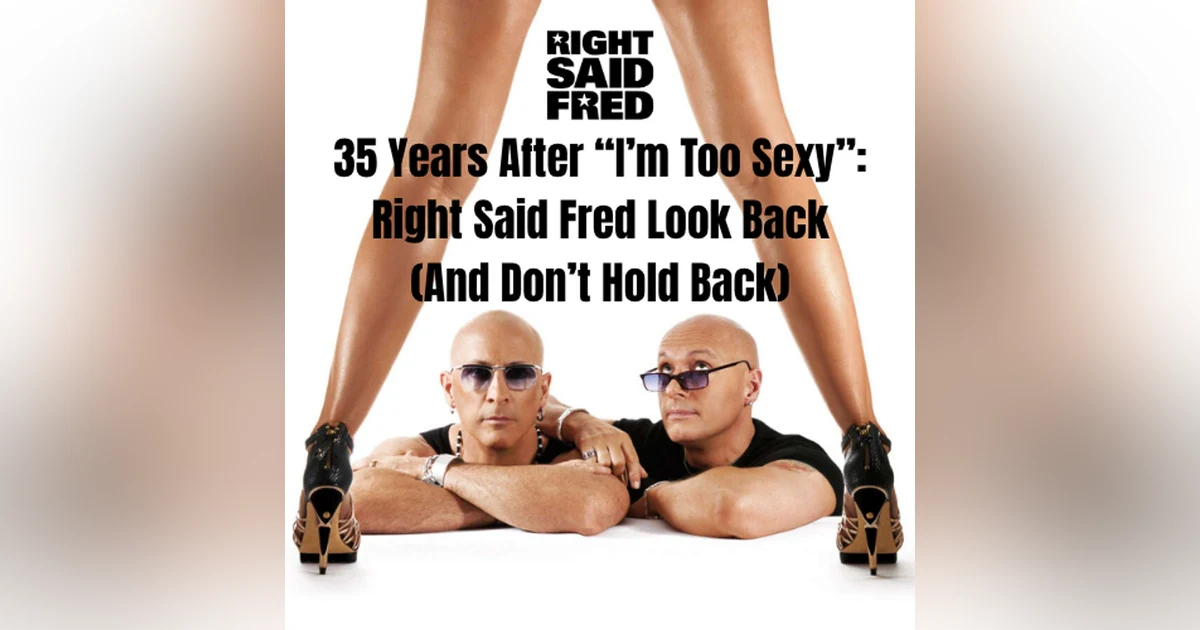
35 Years After “I’m Too Sexy”: Right Said Fred Look Back (And Don’t Hold Back)


 Apple Podcasts
 Spotify
 Castro
 RSS Feed
 They’re the British brothers who turned a gym-inspired joke into a worldwide phenomenon. Richard and Fred Fairbrass — better known as Right Said Fred — exploded onto the scene with “I’m Too Sexy,” a debut single that hit Number One in America and made them the first act to do that since The Beatles. Hits like “Deeply Dippy” followed, along with millions of records sold and a career that has now stretched more than three decades. Still independent, still touring, and still making new music, the Fairbrass brothers have outlasted the one-hit-wonder label many tried to pin on them. Today on The Trout Show, we sit down with Richard and Fred Fairbrass of Right Said Fred for a conversation about fame, family, and life after “I’m Too Sexy.”
Your comments are appreciated!
Thanks for listening for more information or to listen to other podcasts or watch YouTube videos click on this link >
https://thetroutshow.com/

Raise your hands [music] and give me
words of distraction. Raise your hand.
words of distraction. Raise your hand. [music]
I need to see somection. Raise your
I need to see somection. Raise your hands.
hands. [music]
They are the British brothers who turned
a gym inspired joke into a worldwide
phenomenon. Richard and Fred Fairbrass,
better known as Right Said Fred,
exploded onto the scene with I'm Too
Sexy, a debut single that hit number one
in America and made them the first act
to do that since the Beatles. Hits like
Deeply Dippy followed along with
millions of records sold in a career
that has now stretched more than three
that has now stretched more than three decades.
Still independent, still touring, and
still making new music, the Fair Brass
Brothers have outlasted the one hit
wonder label many tried to pin on them.
Today on the Trout Show, we sit down
with Richard and Fred Fairbrass of
Wright said Fred for a conversation
about fame, family, and life after I'm
too sexy.
I'm too sexy for my love. Too sexy for
my love. Love's going to leave.
my love. Love's going to leave. [music]
[music]
I'm too sexy for my shirt. Too sexy for
my shirt. So sexy [music]
it hurts.
I'm too sexy for millenn.
So the first thing is after watching you
guys on a lot of interviews and all the
things nobody ever talks about your
early your early life.
No they don't actually
they never ask you a question about
because you guys have been in I think
Richard you and I are almost the I'm
about nine months younger than you.
Right. Okay.
Right. Okay. Okay.
Fred you're quite a bit younger than
your brother. Correct.
Three years.
Oh. Oh. Three years. Okay. Well, that's
there there's there's Wikipedia. There
you go. [laughter]
There's Wikipedia for you.
I remember talking I asked one guy and a
musician. I go, "Hey, did you know you
have a Wikipedia page?" Really? I didn't
know that. [laughter]
Well, they're not really worth looking
at to be honest.
You can selfrect. You can selforrect,
Oh, yeah. Well, and then I had I had
years ago I was working with a guy that
was on television and um I had to book
his flight and I said you that said,
"This is your birthday." Goes, "That's
not my birthday." It was Wikipedia. So
it's like, you know, you can't do it.
Anyway, so which one of you guys started
Anyway, so which one of you guys started playing
and what did you start playing first?
I mean, which
Okay, so Fred, you picked up what did
you pick up first?
Acoustic guitar.
Acoustic guitar. Okay.
Yeah, I I momentarily picked up a um
classical guitar uh for a little bit and
then I moved on very quickly to um I had
an Echo 12 string um and I had a I
started getting lessons from a guy
called Mr. apprentice
and he um I showed him what I could play
which was some very basic scales and
And and I had my classical guitar and he
said, "You don't strike me as a very
classical kind of guy." He said, "Maybe
we should try you on acoustic and maybe
try some blues licks." So he said, "Have
you ever heard of Big Bill Brunzy?" And
I said, "Nope, never heard of him." And
he said, "Well, you're going to hear him
now." and we played some stuff and then
I he started teaching me all the little
returns and the turnarounds and and the
finger picking and stuff and I I was I
was with him apprentice probably about
two years then I selftaught and then I
went back and forwards different tutors
I do I still use tutors but I they tend
to be online now just because the
convenience of it.
convenience of it. Yeah.
And there are some very very good tutors
guys like Paul David and Marty Schwarz
Oh yeah. Yeah, I I [clears throat] Yeah,
they're very I like them because they
don't talk to me like I'm an idiot, but
they consider that I might be.
they consider that I might be. [laughter]
Well, I I you know, I I grew up playing
when I started at 12. And you know, I
learned I had two years of lessons and
then the guy I was taking lessons from
said told my mom I can't teach him
anything anymore and I don't know if I
suck so bad or I knew more than him and
you know, you know what I mean? So
I I learned by playing and you know I I
started writing songs when I was in the
eighth grade, you know, all that stuff.
Um but when my back in the 90s I was in
a band, we were doing really well in the
Midwest and and I just take it to a
friend of mine. He was a teacher and
they'd say, "I want to play this song."
Cuz I'm a league guitar player.
So instead of sitting there and figuring
out, I just took it to him and 10
minutes later he go, "All right, here's
the league part on this Eric Clapton
song. Done." you'd be done with it.
Now, the last band I had, we were broke
up during that thing called COVID. We
were doing pretty well and people would
go, "What do you want to do?" I just go
to YouTube,
you know, and instead of me, I mean, I
could figure it out, but eventually
what's going to happen is, "Okay, oh,
they're playing it there."
You know, okay. How's he doing this
little lick? Oh, okay. Gotcha.
Yeah. Me, too.
Sorry. It was like that guy Fred was
telling me about who um who did a thing
on a Paul Simon song about about
that was Paul David was talking about
that was Paul David was talking about that.
Yeah. And you know did the whole thing
like this is how he Paul Simon does the
chords and Paul Simon comes back to him
and says no
that is so cool. Yeah.
So so to get an email from and and
obviously he was probably very polite
and and what an honor you know just for
one one small mistake.
Absolutely. I was playing
and it's funny he caught it.
and it's funny he caught it. Yes.
And I wa I watched what Paul David did.
It just showed up again on my feed and I
go it was like one note off.
Yes. Yes.
It was like one little little drop down
on the your finger ping you know
whatever and I'm going my god he figured
so get back to you. You learned the
famous 145 because that's where
absolutely 100%. Yeah. Yeah.
And you know for years I didn't I didn't
even know what they were talking about.
I literally didn't I go and play I mean
I've been a blues guy for me years I
grew up in Texas I saw Zezy top before
they were big you know all the people
Stevie Ray
and I'd go play and you guys we're doing
145 and I'm going like what the hell are
you guys talking about [laughter]
145 I go and they'd rehearse 14 until
finally when I started recording I have
a keyboard right here I go oh
14 [laughter]
absolutely right yeah
don't you think It's amazing that Beth
Hov never never noticed that.
you know what I mean? Blues thing was
there the whole time. [laughter]
And never thought about that.
Yeah. Never thought about it. I can't
get my head around that.
What did he know?
What did he know?
What did he know?
No, it's like I was talking to somebody
yesterday. Uh marketing company wanted
me to work with him and and she was
saying she learned how to play Beethoven
and she wanted to play Moonnight Sonata,
I think.
Yeah. uh one of those and I'm like you.
It's like why didn't he go like let me
jam over here. Wait a minute.
I I feel like I Wait a minute. I don't
even know what a pickup truck is, but
I'm going to start singing about it.
That's probably [laughter]
Exactly. It's always surprising to me
that. Exactly.
So, Richard, did you do you play too? I
mean, I Fred, you started playing.
Yeah. Because I I know I I a lot of
interviews you guys started I think a
lot of people don't realize this when
they talk about people like yourselves
have been in the business. You went
20ome years working
trying to make it.
Yeah. We're sort of like Nigel Farage in
that in that respect. [laughter]
Yeah. Exactly. I know.
I kind of like him, you know.
Yeah. I know. Me too.
People are allowed to. Yeah. Absolutely.
So um what happened was I I started
playing guitar because I wanted to write
songs. I was fascinated how do you write
songs? Then then I got into Stevie
Wonder and I started learning all the A
major 7ths, the minor 7ths, all these
little chords which are not in the
slightest bit rock and roll at all.
They're all very
moody songs and
so it sort of took me down the wrong
path for a while and but then we just
started playing bass
because he's a Paul McCartney fan and
Sting and people like that. So we just
started playing bass and then we just
started working out stuff together and
bit by bit we we put together maybe 20
minutes of songs half an hour songs we
never played cover versions other
people's songs we didn't want obviously
they're great songs I'm not disputing
that but we didn't have the to play them
we just thought let's write our own
songs so we we were on the road touring
from 7078 we first toured with suicide
in 1978 in the UK Okay. And Suicide, for
those of you who people don't know, were
a New York electronica band. Very sort
of edgy at the time.
And we toured with them. And then we
went in and out of record deals through
the 80s. Got picked up by various
independents, picked up by Capital EMI
in America.
And typical sort of stuff. These record
deals fell through and you'd come back,
you think, well, and and the things with
my brother and I, we're really stubborn
people. And so if someone says, I don't
like that, our first thing is we do.
Yeah. We do.
That's that's interesting and that's not
always a great trait because sometimes
you can learn from other people's
comments. You definitely can.
comments. You definitely can. Sure.
Um so that sort of stubbornness can be
negative. But then so we went in our cut
long story short, we got to 1989 having
been around bands and in and out of
record deals about 8 n 10 years and then
we um put together right said Fred and
we just started playing some songs
acoustically in pubs and bars and we
actually attracted quite a lot of record
company interest and but we weren't
interested in a record company deal. We
weren't the deals we were done with sick
of them. So at that very point I started
getting into dance music. I started
hearing house music, Mars, pump up the
volume, all this stuff. And I was just
thinking, this is just epic and why
can't we copy a bit of that and add
guitars? Can't we why can't we do that
without it being disco, you know?
So So we farted around for ages. Then we
eventually met a guy called Rob Manzoli.
And the first song we wrote together as
a as a as a piece with the idea of
putting guitars on sort of house was I'm
Too Sexy. That was the first that was
the first song. That that took us about
6 months.
Yeah. To finish from from start to
Well, it's got a kind of AED kind of
thing going on. And I noticed even your
last song I listened to that you got out
like six months ago, what? Raise Your
like six months ago, what? Raise Your hands.
Raise your hand.
It has that same kind of
It does. Yes.
And I And I like that. I mean, I like
that. I mean, it's not The thing I like
about it was
it's not rock and roll.
It's not It's It's It's
different. And and I got to tell you
guys, when I listened to your last tune,
I was listening to it last night,
listened to it again this morning. I
like the way you record.
Oh, thank you.
It's very clean. You don't have a lot of
stuff going on.
But you got some really cool effects
like the guitar on that song
and it's just And then it's got the beat
in it, which of course I watch some of
your live videos, which you come out and
that's your that's kind of your gig
obviously, but that's because you like
obviously, but that's because you like it.
Yeah, we do. Yeah. Yeah. I mean, we we
we've just added Raise Your Hands to the
set for the the summer festivals have
just gone, and we open with it, and it's
it it um it connects immediately with
people. It's it's probably the best
opening song we've had for a long time,
and the song performed really well. Um
it was picked up for the World Cup this
year and also
Yeah. And also charted very well in
various independent charts. So, um so
we're very pleased with that. Going back
to sectioning and that was sort of our
you know we we we kind of shoehorned
you know we we we kind of shoehorned [clears throat]
the the guitars in there because we
initially it it didn't actually need
them but so we put some heavy distorted
guitars right at the beginning just
doing the the three chord trick and then
we then the actual melody I'm a model
was written on guitar.
That was a guitar riff.
And the melody I'm too sexy was a bass
riff. So we just thought well if we're
singing the bass riff let's sing the
guitar riff. I mean, you know, that's
what we did. And uh and I had the lyric
and um so we we put it together about
over 6 months. We it took that time
partly because we had no money. So we
had to save up, [laughter]
you know, we had to save
like every starving artist in the world.
like every starving artist in the world. Yes.
Amazing. We borrowed the money from a
Yeah. We went to our back in the day
when banks were doing the right thing.
We actually got the loan uh to remix.
Was it the remix?
Yeah. Yeah. We recorded a remix Sexy for
50. You'd already recorded the song, but
you had to remix it and
get it mixed. Yeah.
So, you had to go find an engineer and
go in the studio and pay them. Yeah.
While you sat there and Yeah. Okay.
Yeah. We had to we found a guy DJ called
Tommy D who did a great job. Um Graham
Bennett Bonnet was the um was the
engineer and Phil Sporting was the bass
player. And it was those three people
who really helped turn the song into a
Yeah. Um and um
the studio that we used was actually
dark. The way basically what happened
was it was a studio that was all I don't
know whether it gone bust or whatever it
was in receiver ship
in receiver ship and they said you could
you can record here at night but you
mustn't put the lights on. Nobody knows
you're here. So the only lights that
we're allowed to use off the bed was on
the desk. Yeah. I was going to say the
big deal.
Yeah. And I they we had some in a small
um sort of promotion company at the
time. They said, "What about doing it in
French and Italian um and Spanish?" So
we said, "Okay, fine. Okay." So I
learned those three languages
phonetically because I can't speak those
phonetically because I can't speak those languages.
Sure. Yeah.
As an example, in Italy, um my Italian
was so bad they actually played the
English version. [laughter]
So So there you go. Yeah.
You know what? I think one of the
interviews I I may have been with Nigel
maybe somebody else you were talking
about how you everybody wants to know
about that song how you wrote it and all
that stuff
but what you did I think Fred you said
something about which was interesting I
was all ready to come and go to you guys
until I saw this all right what did they
say at the label when you brought this
to him and then I see this interview
like and I hadn't heard this word a long
time you said the word acetate
and you said you took the acetate and
I'm thinking people don't even know what
that is
And and you brought the acetate in and
then because that's obviously we grew up
with records.
We don't call them vinyl. We call them
We don't call them vinyl. We call them records.
And I and I said, "Oh, that's what
And I and I said, "Oh, that's what happened."
And And [clears throat] I do I do
sometimes songs about
famous songs that were not supposed to
be famous.
Yes. So that's
where it was just like
they didn't the people didn't they
wanted the aside
but everybody started playing the B side
I will survive
I will survive was the B side was it
you know and uh the steam song
you know that song they didn't want that
one at all it's then all the DJs started
playing the other side
so this is the one thing I always think
about when I see about an iconic song
like that
when did it come to your mind? All
right. You started getting some
right. You started getting some traction.
When did you guys look at each other and
go, "Holy
this thing's blowing up."
Yeah, it was really surprising.
It was in America.
In America, that's when it first dawned
on us. I think
we've been number two, in fact, in the
UK for like eight weeks or seven weeks
or whatever it was. But then we started
breaking abroad. So we were going to
Holland and Spain and Italy and all
around Scandinavia. Then early 2002
2002 92 early 1992 we heard it was
breaking in America on import and then
um Charisma picked it up. So um we
thought okay. So anyway we we decided to
take a break because we'd been working
for about nine months without without
any any time off. So we we went and had
a break in um St. Lucia and um we got a
Not a bad place to have a break.
No. Nice place.
Nice place. And and literally the day we
were leaving, we were all at the um
airport and back then in '92, it was a
tiny airport,
And the phone starts ringing. There's
this concourse. It's just us and few
other people. Phone on the wall. Phone
on the wall starts ringing. There's no
word of a lie. And um so we're looking
around. So our manager, Tam, she said,
"Well, okay, I'll go and pick it up."
She picks it up and said, and they said,
"Right, say Fred there." said, "Yeah,
how can I help?" "Yeah, you've just gone
number one in America." And we're like,
"So, she starts crying." Yeah. Starts
"So, she starts crying." Yeah. Starts crying.
So, we think
That's sweet. That's sweet.
We think [clears throat] we think there
some death in the family or something
really horrible happen. You're only
hearing her. And then, oh my gosh.
Yes. [laughter]
We're only hearing her side of the
conversation. I said, "So, she puts the
phone down and she's like this." She
said, "Arty sex is number one in
America." And we all went, "Holy." And
that that point we suddenly thought,
"Yeah, that's pretty big."
Just just prior just prior to us leaving
for America to promote. We had never
been before. So we're going to America
to promote it for the first time. We met
Michael Stipe from atm
at the Brits. And we we were standing
backstage and he said to us, "Sir, so
you guys off to America, are you to to
for promotion?" So he said, "Yes." He
said, "Man, it'll kill you." [laughter]
Right. And [clears throat] he was right.
There was there was nothing there's
nothing to compare with being number one
in America, I don't think.
No, it's it's a unique experience.
Yes, it is.
You know, it's funny when you think
about it because I grew up, you know, at
the Beatles.
the Beatles. Yeah.
I try to I try and you guys did too. So,
and I I try to explain to people how
they changed the music industry
and and they just don't get it. I mean,
they I know you guys Swift brought one
of your songs in and prodded one of your
songs, but you know, they see that and
go, "Well, look how big she is." No, you
don't understand. They would do a
different song and change the whole way
people were doing things.
And they go, "How what do you mean?" I
said, "They just it was like you
couldn't repeat it. I don't think you
can ever repeat it again what they did."
The one other thing too I noticed about
you guys and I tell people especially I
like interviewing younger artists that
are indies coming up
and I always tell them the same thing
and this is what I know both about both
of you. I've never met you but I can
tell by what you do.
You don't take yourself seriously
and you're having fun.
and you're having fun. Yes.
Even all the years you've been doing it,
you still have fun.
And that's you have to That's all that's
That's all that's I mean
That's all that's I mean [laughter]
Well, and if you can be iconic, like I
mean this morning, I mean last night,
yesterday I heard Dolly Parton died.
Everybody in the world knows Dolly
Parton. Everybody knows,
right? Yeah.
And there wasn't a person I started my
social media started blowing up.
Everybody was saying the thing. People
from all over the place were saying, you
know, what a great person she was. And
if you can have that when your career
if you can have that when your career ends,
of course, you're not here to enjoy it,
but if that's what your life means.
Exactly. No, I agree. Absolutely agree
with you. I agree.
I mean, and so the thing about what I I
I mean, and so the thing about what I I watch
watched your old videos. I remember one
of them you were actually watching your
old video going, "Oh my god, look what
we looked like when we did this."
we looked like when we did this." [laughter]
Yes. My god.
But the other thing is
you didn't ever I mean it was funny. So,
you know, it wasn't funny because I mean
look at as we say in America, cha-ching.
Cha-ching cha-ching.
And you got in the you got in it when
they were still paying. There wasn't
this thing called streaming.
this thing called streaming. Exactly.
We were very very lucky. We got in under
the wire.
I think it all started going wrong about
10 years later. Really?
Yeah, it did. I mean, we were still I
mean, they were buying CDs in 90s.
Yeah. We were selling vinyls, cassettes,
and CDs and u
and you know, we were I think the album
I can't remember how many how the album
the album sold a lot, many millions, but
I can't remember exactly. But um I I
think it's it's for to describe that to
people these days is quite difficult
because people had to physically go into
a shop, interrupt their day, their lunch
hour, their plans. They had to go to
shop, possibly queue up, have the money
on them, buy the physical thing, and
take it back to work or wherever they
were going or in their gym locker or
whatever it was. It's much more of an an
event. you you you psychologically
thought, I want to buy this record.
Yeah. And you and and and it's it's a
bit like was you you had to put as part
of your shopping. You'd go to the
grocery, you go there, you go, oh, I've
got to go to the record shop. Now you
can you can that that's not even part of
your thinking. You you can stream on
your phone or or whatever. And I think
that sense of belonging
um has gone which is I think and I know
people talk about there's a bump in
viable ownership or purchasing, but I
think that's very genre specific
in the Yeah. In the local in the local
record shop when we were kids, there was
each um there were about four or five
listening booths
and you could walk.
I was going to say I grew up listening
to 45s. You go in and listen headphones
Yeah. Well, this didn't even have it was
it's like a little room.
Oh, so they had little speakers there
you could listen probably in mono. It
was probably in mono mono. Yeah. But you
could sit in there with your friends.
What's interesting about social media
and this whole thing is that it's
actually separating people. It it's it's
actually destroying that face to face
communication that used to be so much a
part of it. Which is why a live work is
so much fun because there's nobody
standing on the stage between you and
the audience saying, "Don't listen to
this. I don't like it."
It's just you and the punters. And if
the punters don't like it, then you're
in trouble.
Well, as I tell artists,
people want to like you when you walk on
stage. No matter who you are, it's your
job to keep them liking you. [laughter]
Exactly. It's like a first date, isn't
Yes, it is. And and they will let you
know real quick whether they like you or
know real quick whether they like you or not.
And the other thing I had I was talking
to my wife about this the other day
to my wife about this the other day about
she she's not she doesn't get she
doesn't understand all that stuff. She
says the agilation and all that that
doesn't mean anything to her.
And I said, "Let me tell you something.
When somebody starts singing your song
in the crowd, that is one of the coolest
things that can happen to you.
It is. Yeah, it is.
And I mean, obviously you got the
iconic, everybody knows that song, but
when it first comes out and you're
hearing people, wait a minute, they're
singing what, you know?
singing what, you know? Yeah.
And when you especially when you tour
and you're in Japan and all of a sudden,
oh, I'm so you know, [laughter]
and you're like this blows your mind up.
It does. I I was in a cafe in Barcelona
about 3 years ago and there was a young
girl behind the counter and the cafe had
just opened. I was sitting there having
a cappuccino. She's tidying up and
everything and she's um the radio's on
but I can't quite hear it and I thought
I recognize it cuz it's us and she's
singing singing along with Don't Talk
Just Kiss. She's about 22 years old and
um just dancing around
thinking you don't know that I co-wrote
that. You don't know that. And I thought
I it was a real moment. A real moment.
I mean, you probably I know you don't
want to, but you really want to go up
and say, "Hey, guess what?"
You don't want to. Yeah, I'd understand.
I [clears throat] get people that write
music for TV stuff and they'll be in an
airplane. I had one artist tell me he
was in a plane. Airplane music goes,
"Oh, I wrote that." Nobody knows. No.
And I think one of my favorite stories,
I have no idea if it's true or not
because I've never met Sting, but when
he knew he was famous,
was his wife was having a baby and the
window washer was outside and as he came
down the hospital, he was singing Roxan.
And that's when he realized, oh, I guess
I'm pretty well known now that that
they're singing my song.
Yeah. Yeah. Absolutely. I remember I
remember No, go ahead.
I remember seeing I remember seeing
Sting on. We had a a rock show which um
um what's it called? Um the late night
rock show back in the day. Whistle.
Whistle test. And
Oh, yeah. See people, man.
Yeah. And I saw Sting there police
playing for the first time and he had he
had sprayed he meant to use underarm
spray deodorant and had sprayed it in
his eye by mistake. Do you remember? So
I think and he wore dark glasses on it.
Yeah. On that. I should have never
because it was all Yeah. Cuz it's um
alcohol. A lot of alcohol. Yes, it's all
alcohol. Yeah, exactly. But yeah, that
that whole um that moment that's that's
why the American thing for us was so was
key because that's when you realized um
that that it was it's a different order
of fame in America, I think.
Yes, it is.
Um it's just so you can you being famous
in France or Germany is great. You know,
it's all having a number one in those
countries. But what's great about
American music and culture generally, I
think, is the way it evangelizes what it
think, is the way it evangelizes what it is.
It sells it abroad. You'll have some
really big bands in Germany that nobody
outside Germany really knows about. They
don't evangelize it in the same way that
the Americans do. And I I I really like
that. I really like And Britain used to
do that. We used to do that with with
the Beatles and the Stones and all that.
Those bands in those days, we used to be
quite um you know, we quite creative in
that way having international acts and
that's kind of I think at one time it
British acts were 30% of of the um
billboard. Yeah.
Oh yeah. Yeah. Yeah. I mean, back in the
60s, that's you couldn't get away from
everybody. It was all the Murzy Beat and
all this stuff out of Liverpool and
everybody, you know, everybody then
wanted to get on.
I was listen coming back from lunch
yesterday. I was listening to serious
radio, the Beatles station. It was Paul,
it was Peter Asher on there.
He has a show. I didn't know that.
No. No. Yeah. Yeah.
You know, and of course reliving his
talking about I the end I'm going, "Who
is this guy?" And he goes and I look at
him, "Oh, it's Peter Asher." And I'm
going, "People probably don't even know
who he is."
Yeah. Yes,
relationship with Paul McCartney and all
that stuff. But, you know,
but I I think the thing about it is um
you have to this is this is what I
always ask. I I think about stuff like
this when you've you've written a song
that everybody knows.
How do you and I know this is probably a
funny question. How do you keep your ego
in check? Do you have like spouses or
friends that just say things like my
wife would say, "Hey, dude, you still
put your pants on one leg at a time."
[laughter] I mean, I mean, you could
easily walk out and go, "Hey, guess what
I wrote."
And let your ego take a float with you.
But you guys don't seem to be that
doesn't seem It doesn't even seem to get
to you guys like that.
Doesn't it never bother you?
No, I I I've never really I mean I one I
liked getting good seats in restaurants.
That was cool. [laughter]
Yeah. But really I've never really um
I don't know. I've always I I we I love
music and I love the music industry. I
find the music business ridiculous.
Oh, yeah. Everybody Yeah.
It is just It is just pathetic.
I call it the business of music. That's
what I tell young artists.
Well, it is. Yeah. And I have this
conversation all the time. The music
industry is in two bits. There's the
industry which makes the music, you
know, DJs and writers and players and
blah blah blah blah. And then there's a
business which sells it and tries to
monetize it. Um and um the music
business is often populated by people
who don't like music or don't or if they
do they don't like much music or have
never been musicians.
No, the suits. We call them the suits.
No, the suits. We call them the suits. Absolutely.
And that's where it can not always but
it can fall apart. So I think for us we
um we we we we love writing and playing
and we we put a lot of work into what we
do live and what we record. But once
that's done, we tend to view it with a
bit of a through we tend to view it
through a prism of it's all ridiculous.
I Yeah,
I think fame is as well. Fame is pretty
Yeah. I think we're both we both look at
ourselves as if we're another person
when we're doing things like when we've
done the any red carpet stuff
or the the media board. I'm always
really we're both kind of embarrassed
by the whole thing. I find it really
quite awkward. And yeah, we went to one
a big big uh film premiere with um uh
who was in there. John Travolta and a
who was in there. John Travolta and a couple
couple who's
the guy who died. Yeah. And um I hired a
suit. I hired I rented a suit for for I
get Yeah.
Yeah. And as you walk down the red the
red carpet, they film you and then when
you're in the theater, they show the
film they've just shot of you arriving.
So I didn't know that. That's
So I didn't know that. That's interesting.
Yeah. So, I'm sitting there in the seat
and then suddenly there's a picture of
and then suddenly there's a picture of me
me arriving
arriving in what looks like the sort of
suit you would buy if you were really
cheap secondhand cast. I looked
cheap secondhand cast. I looked terrible.
It wasn't a good suit at all, you know.
So, that and I just thought I can't this
is not me. I just cannot I can't do
this. And also, we're quite it's not
it's not a kind of um Tourette's, but
it's a we both have an a tendency to
blurt things out. We say things we
We probably say things we should
Oh, I figured that out real quick
watching your interview. So, I figured
that out.
Yeah, we got trouble. We got into
trouble with Beyonce at one point. Um,
and so we do that's so that that's
another reason probably why I find them
a little bit stressful because I don't
like having to watch what I say.
We not very diplomatic.
Do you know what I mean? So, I find that
quite I think a lot of um stars in in
all types of entertainment are probably
quite well schooled. They probably go to
training media media training. We've
never had this.
And we've never ever we've never, as you
can probably tell, we've never had that.
Well, and don't take this offense, but
you guys are lucky because you could go
you guys are lucky because you could go in
and nobody really knows who you are.
I mean, that's that's probably what the
the advantage of it is because I think
you're you're probably right because you
can't say what you really think
can't say what you really think sometimes.
You have to be careful
particularly now. Yeah. In the last 10
because Yeah. the social media people
pick it up and they blow it up and the
next thing you know and you're right
said Fred we're never going to see them
again they're two of the worst guys in
the world you know you said something
about somebody's dog once and you're
like I never said you know yeah
yeah exa exactly I mean yeah autographs
I think of the two there's photographs
and um autographs I think autographs are
the weirdest
self is a very common
self is a very common
Oh yeah
yeah yeah
and I'm not good at it
so I I think you guys are kind in the
right place where you know Steelely Dan
was kind of the two guys that really
kind of started all that stuff. They
didn't want anybody to know who they
didn't want anybody to know who they were.
Not exactly.
They just they they didn't want to put
their picture on their album.
But I want to go back what you said,
Fred, about music.
And that is I grew up reading liner
And that is I grew up reading liner notes.
notes. Okay.
Get the album. I'd read the back of it.
I want to know who the producer is. I
thought it was interesting to me, you
thought it was interesting to me, you know.
Yeah. You know, and if it was a double
album, you go look at all this stuff and
you're thanking people. You're going
like, "Here's Bill that brought me
coffee." You're like, "Who's Bill?" And
he brought, you know, all the weird
stuff like that.
Also, it really bugs me that the people
don't get credit anymore. If you go on
to Spotify, you should be able to get a
credit. Who's the songwriters? Who's the
producer? Who engineered it? And even
though even the even those very basics
should be visible on all on all
streaming platforms. And it's the
visibility. If I was a producer, you
know, so well, we do produce sometimes,
but songwriter, player, I I I should get
that credit. I I think it's really sad
that that musicians and the the
important the team because you can't
make a hit without
Yeah, you got a team. Yeah.
You know, are invisible. I think it's a
Yeah, I agree. I agree. What you were
saying earlier about Steelely Dan, they
did an album. I don't know which one it
was. And on one of the sleeve notes,
there was a list of all the equipment
that they used in the studio. the the
type of mics that the
Yeah. Everything everything was if when
you're a kid.
Is that Press Logic?
I can't No, I don't think
it could have been I don't know which
one it is, but I know I remember that
one it is, but I know I remember that album.
Yeah. And it was it was really And as
you both said, it's really interesting.
I think every every famous song behind
every famous song there's a team of
people. Yeah.
Of one kind or another. And increasingly
that team are getting more and more and
more invisible now. And it's just and
even some I mean some stars who have a
hit sing a hit record written by
somebody else. I mean it's the only
thing that's that's there is that their
name and the song title. That is it.
name and the song title. That is it. Yeah.
There's no remember on the 45s it had
everything on it. Ask BMI produced by so
and so written by so and so. I didn't
know Ringo Stars name was Richard Starky
till I saw it. They wrote my song
Richard Starky. I didn't know [laughter]
Richard Starky. I didn't know [laughter] that.
Yeah. Well, I was watching I'm a huge
Sonatra fan and I was watching him at a
gig some on TV and um what was great
about Sonatra every song he did he
introduced he introduced it by naming
the writer,
naming ranger and naming the orchestra.
Yeah, he was all it seemed to me at
least he was really aware of the fact
that he was merely a voice for the work
that those guys did. M we did sorry we
did a session
we were doing a session at Abbey Road
about where was it now 2019 2018 and
[clears throat] we got them the amp and
everything I'm using a deluxe reverb or
something and the guy says what mic do
you want to use I said I don't know
you're the engineer you just tell me he
said should we get the mic that John
Lennon used Don Sus and so I said um I
said how are you going to know that he
said well ask Lester so I said who's
Lester he said he's Lester he's the
microphone tester he's been here since
1950, whatever.
My gosh.
And he and not only have we got all the
mics, he'll tell you what he'll he can
take you to the microphone that they
miked up. Lady Madonna on the piano.
He'll take you to the microphone they
did this. He can show you the vocal mic
they used for this. And he said, "What
mic do you want to use?" I said, "Well,
don't tell me who used it, what it was
on, but just get me a mic you think it's
going to sound great."
Yeah. I did. Yeah.
But it was really interesting. It was
And we met Lester. Lester came to say hi
and he was a lovely guy and he could I
mean he
was he in a suit?
Not really.
No, you know back in the day they all
wore suits.
Yes. I think he had one of those I think
he had a V-neck jumper over shirts. So
was sort of cloak casual getting
office, you know. But he he was a lovely
I don't know if he's still alive. He was
a lovely man and he could tell you every
mic that the not just the Beatles but
you know Floyd and everyone else used.
Yeah. I think they've still got the
piano. The lady
probably is all these famous people.
They get 10 people in a room to write a
song for.
Oh, don't we? Oh, don't tell me. But I
know. I know. I know.
Well, they'll go in and go because it's
digital. They'll go in and say, "I don't
like that word. Let's take that word
like that word. Let's take that word out."
Yeah. Yeah.
And you're like, "Well, that's not
And you're like, "Well, that's not real."
No. Also, the other problem is
production royalties are so crap now
they're handing it out right.
That's the other problem. So they're
handing out right um publishing
royalties like the candy. So you you the
two or three of you can take a song to a
well-known writer singer and by the time
that singers finished your your three
three-way split is a 20-way split.
Yeah, I've seen that. I've read about
It's a it's a nightmare. Absolute
nightmare. When we we get asked a lot
about um what if we had advice, what
sort of advice would we give to young
sort of advice would we give to young players,
right? One of the things I think that we
were guilty of and I think a lot of
young when we started a lot of young
players are guilty of it too is that you
think you need the guy on the other side
of the desk. But the truth is the guy on
the other side of the desk needs you.
That's right.
You've got you've got the gold in your
You've got the asset.
You've got the asset. And young players
are far too keen to hand everything over
to this this figure who they believe
will do everything for them. Do you know
what I mean? And actually if young
players could remember that they've got
the asset. They might have the face, the
voice, the song doesn't matter what it
is, but they're in control much more
than they believe themselves to be.
So I agree with that. That's one piece
of advice I would always say to anybody
younger who's starting out. Never ever
ever imagine that you need them because
you don't. Well, but I I think Richard
the problem is a lot of people I talk to
even in their they're really
accomplished music don't think they're
accomplished music don't think they're worthy.
No. Exactly.
I know.
I know. Yeah.
Yeah. Yes.
I I I do believe in the circle of life
and I do think the music industry will
eventually and people talk about AI that
will that will reach its own balance as
well. But we're going to get back to
plug in and play people who can sing,
play, write a song. It will always
someone who's good at that will always
find an outlet. You may not be as famous
as you want to be or you may not be as
happy as you want to be, but you will
find an outlet if you stick to your
Also, that nervousness, that nervousness
you were talking about not feeling
worthy. I saw an interview with Sonatra
and Larry King um a while ago. Yeah.
And said every single time he walks out
on stage, he's never quite sure that
he's going to make the sound with his
voice that people want to hear.
That's true.
He's never he said I can't tell until I
start singing whether it's still there.
Yeah. Pav.
Yeah. So I think it doesn't matter how
big you get.
That is always in the back of your mind.
Is this going to be right this time? And
I remember Paul McCartney saying back in
the day that you know he'll be playing a
gig somewhere and he'll he'll see right
at the back light will suddenly appear
as somebody opens the door to leave you
know and he in his he's thinking oh my
god they must hate it. They could be
going to the toilet. They might just
Or they might just have arrived.
And he's worried. Paul McCartney. He's
And he's worried. Paul McCartney. He's worried.
Yeah, exactly.
Isn't that Isn't that funny?
Well, I guess we all like the agilation.
I mean, it's just it doesn't, you know,
it's like
I was interviewing a guy out of the
Netherlands. He has a great podcast and
he's a great artist to himself. But we
were talking about that a few years ago
and he'd had some of Clapton's people on
his on his show and I said, "Why do you
think MC Jagger and Keith Richards keep
think MC Jagger and Keith Richards keep going?"
And he said, "Rick, can you envision
them sitting in front of TV and watching
soap operas?
No, I don't. I don't see it." And you
know, and the other thing, Fred, if you
listen to the last The Stones album just
came out this year, it sounds like the
Stones from 60 years ago.
It It does. It it has a lot of that
grunge basic stuff that says this is how
we got started. We're going to keep
doing it this way.
Yeah, the riffs I think the riffs are
It's beautifully recorded. I I really
miss Charlie Watts and and I I I think I
I think you'd be hard pushed to find a
drummer. I think the drummer was
apparently picked by Charlie Watts was
one of Charlie Watts's favorite drummers
apparently. I'm sure I don't know how
true that is.
I do miss Charlie Watts. I think he had
such a vibe to him. But it is it's a
very very good sounding album and and
you know not people say oh for their
age. Well I don't give a about
their age. It is man it's a good
sounding album. Um I think Jagger sounds
sounds good. Um band sounds good. I mean
I don't know how much um Keith Richard
was allowed to able to play on it
because I understand he has arthritic
problems. But
I see his fingers now they're like
they're like
but it sounds it sounds good and and
even if he didn't put you didn't play
much. Who cares? It's a still a good
Stones out album. And and who you know,
you have to you have to go some to feel
that you can as an artist that you you
can you can um pick holes in what the
Stones are doing. Don't have to like
them, don't have to whatever, but it's
extraordinary what they've achieved.
Also, also
off the chart,
a lot of artists um being on stage is
their happy place.
It is. Yeah.
It's their happy place. It's where it's
they don't they don't want to just be
sitting at home mowing the grass or
whatever it is, you know?
No, I mean it's it's we all write songs
and when we get done with them, we all
and when we get done with them, we all like,
"Oh, wow. How did I do that? Where did I
always say to people I say
when I get finished doing a song
completely get done?"
And I go, "Where did all that come
And I go, "Where did all that come from?"
from?" Exactly.
You know, where did all those ideas come
from? Why did I decide to put an organ
on the right side there? you know, all
this stuff that comes through your mind
and you're finished after it's mixed and
mastered and you're like,
where all how did this come? And I told
people it's kind of out of the ether.
I mean, obviously you guys have been
doing a long time, you know, what sounds
doing a long time, you know, what sounds good,
but still,
you know, you're still going like you're
grabbing stuff. It comes to your mind.
And and you're like, you know, and we're
always looking for something everybody's
going to like.
Yeah. And also, I think Jackie said it
ages ago, he said, "What you got to
imagine is prior to you doing the song,
there was silence. Yes, that's right.
In that threeinut piece, there was if
unless you fill it with music, there's
just silence.
And that's actually, you know, that's an
interesting way of looking at it, I
think. Um, and I remember Bill Wyman
saying they asked why why why did he
enjoy being in the stones? He said
because I can go on holiday when
everybody else is working. [laughter]
I [clears throat] thought that was a
pretty good pretty good,
you know, and you think about him. He
quit years ago before they even, you
know, he stopped.
I know. I know. And you know, and I I I
guess there is only so much money you
guess there is only so much money you need
when you already have a castle here and
an airplane there and I can go to St.
Lucia on holiday or you know, whatever.
Yeah. Also, some people need it, don't
they? Some people need
Yeah, they need they need it. I I don't
know. I you know, I think about people
like Elon Musk
who can do anything he wants to anytime
he wants to and buy anything he wants
to. Hey, I think I'll buy England today.
Okay. [laughter] Yeah, I wish he would.
I wish he would.
I know. I'm sorry.
It's going cheap. Only the only person
for me, the only person that gave made
it make sense was the late queen because
she did from she's the longest serving
monik ever. She was I know it sounds a
bit corny, but she was always smiling.
She and she was a consistent supporter
She and she was a consistent supporter of
the country and the Commonwealth.
Didn't you guys play for her or meet her
sometime years ago?
We met her. Yes, we did. Yeah, she was
We met her. Yes, we did. Yeah, she was lovely.
Now, I have to ask you this because I've
never talked to anybody. Do they take
you aside and say what you can and do
what you can't do?
They didn't with us.
No, they they No, the she has this
little that she has this person next to
her telling her who you are.
I knew I'd heard that.
Oh, she meets a million people, you
know, every every year. And she was
lovely. She said, "I hear your
brothers." And Richard made the joke.
So, well, that's what mom says. And she
thought that was very funny. And and she
was very smiley. Shook her hands. And um
very short.
Yeah. Yeah. Little lady. and she was
approachable, very lovely,
lasted about 2 minutes and then she was
on to on to the next people.
But in in the UK there's definitely a a
mood um that since she's gone things
have fallen apart both within the family
and I can see that.
Yeah, there is definitely
Yeah, there is. It's not a They're not
They're not happy happy campers at the
No, but those two back I know you won't
send them back. Don't worry.
Don't panic about that. Somewhere
we'll send them somewhere. We won't see.
Well, I just don't want I don't want to
read about them cuz it's like one of
them I won't mention which one thinks
she's really important.
It's like you you married into it,
It's like you you married into it, honey.
You know, you married into it's always
the ones that marry into the money. I
don't I've never understood that either.
She was Wasn't she a yacht girl?
I I don't know.
I think she was a yacht girl in a bikini
on some yacht.
I don't I don't know. I never heard of
her before. They said she was in TV or I
never even heard of her.
She was in admin. And I think she was in
well and over here I don't talk about
politics because it's so oh my god it's
just so deep diving
each other about that
and I'm in Texas. In Texas people go is
it true about guns in Texas? I said yeah
we arrest you if you don't own a gun. So
we arrest you if you don't own a gun. So [laughter]
where's your gun?
I don't have one sir. Go to jail.
Exactly. [laughter]
Excellent response.
Excellent response. cuz people come over
here and and I live I'm not in the
country. I live 30 miles north of
Dallas, but I can go 10 minutes and see
Dallas, but I can go 10 minutes and see cows,
long horn cows. So when people come up
here, I always say take them out where
they have these long horn. They go,
"What is that?" I go, "It's a long horn.
How does it hold his head up?" We don't
know either. You know, it's [laughter]
like we don't we don't understand. We
don't understand it either.
Cow hasn't told you. Cow hasn't told you
Cow hasn't told you. Cow hasn't told you now.
So I was going to ask you too think
about what you said a while ago but what
did your parents say as you became
the right said Fred were your parents
still alive when you became
sex dad wasn't [clears throat] dad
dad already passed yeah
dad already passed mom was alive and we
um she was very very proud and she
wanted to come to some shows and we had
to stop her from coming to shows because
all she did was cry
so [laughter]
I assume that Tears of happiness.
Yes. Yes. We live in hope.
Yeah. So, [laughter]
exactly. God, they're that bad.
Oh my god.
He's such a puff.
Yeah. [laughter]
I can't imagine though looking down and
you're performing. Your mom's down there
whailing away.
Yeah. And she would just she was just so
happy and proud. She was stand side
stage. I'm I'm I'm st I'm playing. I'm
looking. I'm just seeing my mom in tears
and I'm going, "Mom, come on.
We can't have you standing crying at
every show." That is sweet though, isn't
It is. Yeah.
Do you guys have other siblings?
No, just two of us. Yeah.
Just you two.
Just the two of us. Yeah.
They just they stopped and said, "We
don't want any more of these crazy
don't want any more of these crazy people."
Absolutely. Right. [laughter]
I think very wise.
Would it would have been nice to have a
So, what's on the agenda now? You guys
got See, that's the thing I like about
the UK is, and I have a lot of people I
know over there, uh, musicians and such.
Um, you guys have a lot of festivals
that you can perform at.
And you don't have to go very far. You
know, here in America, people go,
you could play all the time in Texas and
never leave.
Yeah, absolutely.
Absolutely. Absolutely. It's a big old
place to
So, you guys had just come off tour,
So, you guys had just come off tour, right?
Yes. Recently,
now did you go to Scotland? Where did
you go? I just reading about it. Where
did you finish up?
The last festival with Summer's End in
Briant in Scotland and then we've been
around Europe, done stuff in the UK,
then we're out again uh next year. So,
we're just putting that those dates
together as we speak and we'll be
announcing those probably in January, I
What's really what's really revoly to
us, to me at least,
us, to me at least, okay,
that when you're putting a set together
and you're putting in sounds and
attitudes and all that, you don't have
to ask permission from anybody.
We don't have to talk to a label, PR
man, a manager.
I understand that.
You can do what the hell you want. And
Exactly. It's your gig. It's your deal.
Exactly. I love that aspect of it. Well,
I think I I just knew that from the
beginning. I'd like you guys because
we're close to the same age. It's always
helps to
Exactly. We all had the same experience
and it's like you're talking about
records and they're like, "You mean
vinyl?" No, I'm talking about
talking about records. Record. Yes.
talking about records. Record. Yes. Exactly.
I want to tell you thank you very very
I want to tell you thank you very very much.
Pleasure, Rick. Thanks for having us.
We It is It's been a real pleasure.
Well, that's it for this episode of the
Trout Show. Hope you enjoyed it as much
as I did interviewing Fred and Richard.
Had a great time with them. Really
appreciate them coming on my show. I
think that [music] they're just two
upstanding guys. I'm glad that they made
it big and I just wish them continued
success. For more information about
them, just go to the website, write said
Fred, and you can find everything
[music] you need to know about them. And
they did release a new tune uh earlier
this year. That's what you heard at the
beginning of this episode. And they
continue to release great music and I
wish them continued success. [music]
And maybe one day they'll be over here
in the United States and we can see them
in person. For more information about me
and my Trout Show and you like if you
like this episode, there's a lot more
out there. I've done over 200 interviews
[music] with musicians from all walks of
genres. you might want to go to the
troutshow.com and check them out because
you probably will find somebody else
that you like. Plus, we always have new
upcoming guests all the time on a
regular basis cuz I'm always mining for
wonderfully talented artists to come on
the show. So, until next time, people,
you know what I always say, it's only
rock and roll. But gosh darn it, I love
it. [laughter]
See you. [music]