
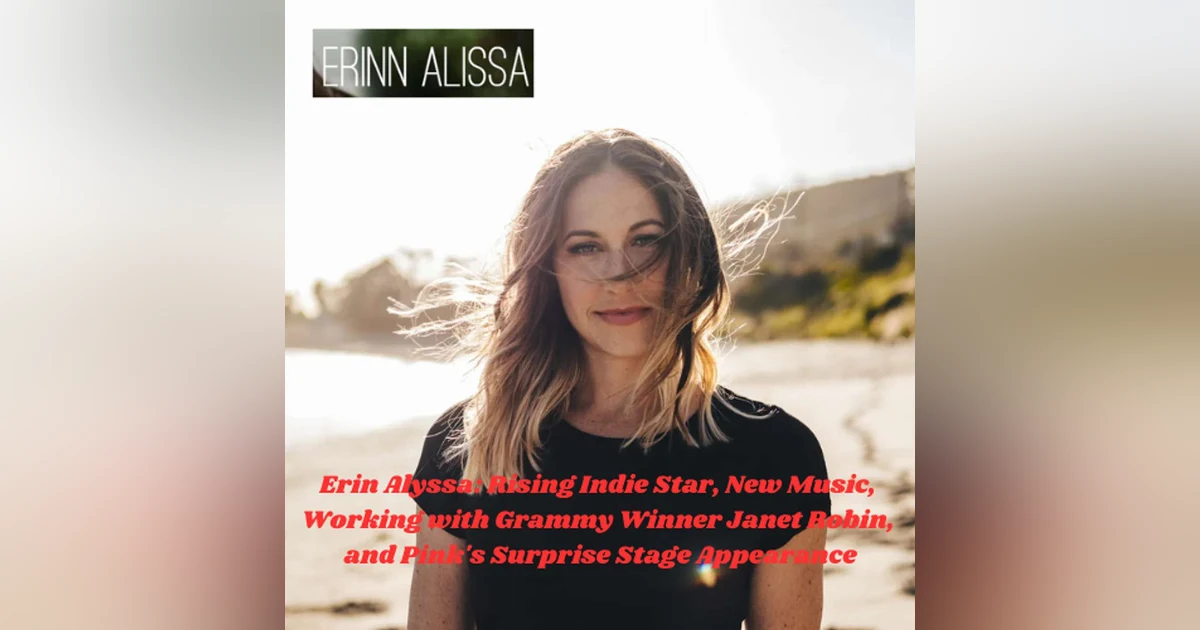
Erin Alyssa: Rising Indie Star, New Music, Working with Grammy Winner Janet Robin, and Pink's Surprise Stage Appearance


 Apple Podcasts
 Spotify
 Castro
 RSS Feed
 Erin Alyssa is a rising talent making waves in the music scene. She just released new music and her highly anticipated album is on the way. Erin has had the incredible opportunity to work with Grammy-winning guitarist and producer Janet Robin. And get this — Pink once surprised everyone by jumping on stage to sing with her at a winery. With her powerful voice and authentic songwriting, Erin Alyssa is an artist you won’t want to miss. Let’s dive into her story.
Your comments are appreciated!
Thanks for listening for more information or to listen to other podcasts or watch YouTube videos click on this link >
https://thetroutshow.com/

Erinn Alissa Rising Indie Star, New Music,
Working with Grammy Winner Janet Robin,
and Pink's Surprise Stage Appearance
[The Trout]
You're walking into the studio, you got the song ready.
[Erinn Alissa]
Yeah.
[The Trout]
So what's the first thing you record?
[Erinn Alissa]
Well, the reason that we ended up using The Village for a few songs was so that I could have the whole band feel, as opposed to like, because some of the songs I farm it out to a drummer and they'll do it at home and then they send it back and then I'll edit the shit out of it. What we wanted was the feel of like a real, you know, record like they would do in the 70s, which I love. And so that's why we chose to record some at The Village so that I would get that whole like band feel to it.
So we did it all, everybody together to have that like really organic, like we're really playing the song feel. So, yeah.
[The Trout]
There's something about that, though. I think for me, I do everything at home sitting right now.
[Erinn Alissa]
Yeah, that works too. It's great.
[The Trout]
But no, what I was going to say, there's something about sometimes I wish I could go in the studio and work with people just to get a different feel for it.
[Speaker 3]
Yeah, yeah.
[The Trout]
Because the thing I was told a long time ago, the first time I recorded was in 94 at a studio.
[Speaker 3]
Yeah.
[The Trout]
And I had put back then it was like little four track recorders I sent to producer and said, here's what I want to do. And he hired studio musicians to do everything. They already had an idea of what I wanted to sound like, which helped a lot.
[Erinn Alissa]
For sure. Yeah.
[The Trout]
But in your situation, you're working with already great people. But what I was saying was the fact that then when you start going to studio, there's that vibe.
[Speaker 3]
Yeah, yeah.
[The Trout]
You know, that helps you out and kind of motivates you to get to the next level. Because there's something very sterile about doing, even when I went in the studio and I had to do vocals, I always pretend that I'm sitting and singing in front of 16,000 people just to get myself pumped up.
[Erinn Alissa]
Yeah, yeah, yeah. Yes. Because there's an energy to music, right?
And what I've been trying to go for with all my music, I'm not trying to go for like the perfected, you know, kind of sterile. Because a lot of the music today is overproduced. It's like perfect.
It's this and that. I'm like, I do not want that. I want the feel of the song.
I want the emotion, the energy. That to me is the most important piece for everything. So I would pick like a, you know, a drum track or obviously I don't want mistakes.
But like I would pick one that has the vibe over, oh, was this perfect in every? No, it wasn't. But I like, you know, there's a feeling to it, right?
And same with vocals where I try to capture the feeling rather than, oh, my vowel was really beautiful on this note. You know what I mean? Like, I don't want that.
I want the like, I want you to feel it.
[The Trout]
And you know what's funny about what you just said is the fact that they have, you can fix it so the drums sound like they're off or make them human feeling. And it's like, I mean, it's just it's like, I mean, it's silly. It's like, let's go get a real drummer.
You know, when did you pick up your first guitar? Did you start with a guitar? Let's put it that way.
Did you start piano?
[Erinn Alissa]
Neither. Well, I took some piano lessons as a kid, but didn't do anything with it. I was a singer, actor, dancer my whole life.
I did. My degree is actually in musical theater, and I did musical theater for many years.
[The Trout]
I think I did read that. Yeah. I thought you had a very eclectic background.
It was all kind of related to music, but being in musical theater is completely different.
[Erinn Alissa]
Yeah, very different. And the singing was always my absolute first favorite thing. That was the thing.
And I didn't pick up a guitar until, gosh, I want to say 2012, maybe. I haven't been playing guitar for that long. But as soon as I picked it up, I started.
I always wrote songs, but I didn't have anything to write. So I picked up the guitar, and I learned a few chords, and I immediately started writing and was like, oh, this is like my thing. And so I'm continually getting better at guitar.
I'm good enough to do my gigs and play for myself, but I'm not a guitar player.
[The Trout]
Well, but I think in one aspect, I've been playing decades.
[Erinn Alissa]
Yeah, yeah.
[The Trout]
I'm a lead guitar player, and there's a Marshall amp that sits right behind me.
[Erinn Alissa]
Yeah, I see it, yeah.
[The Trout]
But I think the simplistic approach, because sometimes when I start writing, and if I'm writing with lyrics, I'm trying to find a chord pattern that I haven't done before.
[Speaker 3]
Yeah, yeah.
[The Trout]
So a lot of times I go to YouTube and go, hey, tell me some great chord patterns, something different. And then I listen to my favorite songs, and I go like, well, that's a C and a D and a G.
[Erinn Alissa]
Right, I know, I know.
[The Trout]
So in one aspect, you're really kind of better off that you don't sit around and go, I think an augmented seventh chord.
[Erinn Alissa]
Right, right, diminished sixth.
[The Trout]
So if you're keeping it simple, and I was told this years ago, and I've been in bands my whole life, the hard stuff to play for your band, the easy stuff you do for the crowd, because they don't know.
[Erinn Alissa]
Right, yeah, I know. So many of my favorite songs.
[The Trout]
So then you got your guitar, and you say, oh, I think I'll just play with a gal that's played Randy Rhoads, so you go with that. But I think what's really cool is if you can write a song without having any instrumentation.
[Erinn Alissa]
Yeah, I do that too.
[The Trout]
I mean, that's what you started doing, right?
[Erinn Alissa]
Yeah, yeah, absolutely.
[The Trout]
And that just blows my mind.
[Erinn Alissa]
I still, when I write my songs, the majority of the song comes from the melody and the lyrics. I'm not thinking of like, oh, this would be a cool guitar part here. Sometimes I have a little thing that I'm like, oh, I like this and this, you know.
But generally, my take is like, if a song is good with just a chord being strummed in the melody, then it's going to be a good song when we actually do things with it. If the song needs all the things, I think, to be a good song, you know, I like to focus on the melody and that.
[The Trout]
The kiss method, as they say, the kiss method.
[Erinn Alissa]
Oh, yeah.
[The Trout]
But you know, the other thing about it, that's why I don't use a lot of pedals.
[Erinn Alissa]
Yeah.
[The Trout]
I have friends of mine, famous people that are young artists, they have like 53 pedals on the floor. And it's like, I grew up watching, I had the privilege of watching Jimmy Henry's play. He had two.
[Speaker 3]
Oh, right.
[The Trout]
A wah-wah and a fuzz. That was it.
[Speaker 3]
Yeah, yeah.
[The Trout]
There was no delay. There was no, you know, and then when they came out with the delay, which The Who did, and I thought, oh, my God, that's so freaking cool. But now I look at them and going like, what do all these pedals do down here for you?
[Speaker 3]
Right.
[The Trout]
Come on, it gets to a point where it's like, have you, you know, I don't understand a tuner, but how many delays, pedals do you, you know?
[Speaker 3]
Yeah.
[The Trout]
You know, so I think from the purist standpoint, and I've said this many times, if you can walk on, you kind of mentioned a while ago, if you can walk on stage with a guitar, that's it.
[Speaker 3]
Yeah.
[The Trout]
And people listen to you for an hour. That's pretty cool.
[Speaker 3]
Yeah.
[The Trout]
That means you've got some really good stuff going on for you.
[Speaker 3]
Yeah.
[The Trout]
Yeah. To me, when I read about you and did some bio work on you, you've done a lot of things like that, through your trying to get people to hear you. What was the story you told about Pink?
[Speaker 3]
Oh, yeah, yeah, yeah.
[The Trout]
Were you doing like a winery or something, doing a single, were you just playing guitar and singing?
[Erinn Alissa]
No, that's what I do for my career.
[The Trout]
Okay.
[Erinn Alissa]
So for six years now, I've done about 200 gigs a year.
[Speaker 3]
Oh, wow.
[Erinn Alissa]
I do like 15 gigs a month. I play at parties, weddings, wineries, restaurants. So people listen to me for far longer than an hour, three hours, which I'm very proud of.
I wanted to make a living with music, and that is how I'm able to do that. And I actually love doing cover, because I take every song and I make them my own, and I throw in a ton of my songs also, but I love doing it. But yes, I was playing at a private winery up in Santa Ynez, and I'm just doing my thing.
It was the second gig of the day. I had done a winery earlier that day, and it was a two gig day. And I'm playing something, and Pink walks in, and I'm like, fuck, I can't say that, sorry.
I was like, be cool, Erin, be cool, be cool, be cool. And I was trying so hard to be cool. And then after a while, she comes up to me and she goes, I love your voice.
It is so beautiful. And I was like, thank you. And we locked eyes, and she knew I knew who she was.
And then she popped up, because as I started playing Landslide, she popped up, and we sang Landslide together, which was just so fun.
[The Trout]
Did the people in the audience know who she was until she started singing?
[Erinn Alissa]
Yeah, yeah.
[The Trout]
But she does have a look to her, so it's not like she kind of stands out a little bit.
[Erinn Alissa]
Yeah. They knew who she was. It was not a gig where it was like audience gigging.
I was like...
[The Trout]
You were just playing in the background.
[Erinn Alissa]
Yeah, pretty much. And I think she has a house there, I think. And she knew a lot of the people.
So nobody else was... I was the one who was surprised. They didn't warn me.
But it was really fun, and she was so nice. And I talked to them afterward, and her friend happened to catch the picture, because I was like, man, no one's going to believe me. And her friend...
[The Trout]
Did you get a picture?
[Erinn Alissa]
Yeah, I got a picture.
[The Trout]
But the other thing, too, is what you just got through saying is why I think music is great, because you're doing what you want to do. You're not sitting around going, man, I need to sell out a 10,000 auditorium.
[Speaker 3]
Right, yeah.
[The Trout]
And you enjoy your life, you make enough money. And I tell people, young people all the time, I said, you don't have to be famous and rich and still do what you want to do and enjoy what you're doing. And you're not doing anything like, well, I got to go back to the office today, eight to five.
No, I'm doing what I want to.
[Speaker 3]
Yeah.
[The Trout]
So now you've built up a repertoire enough of people that you probably can gig all the time. Like you said, you do 200 dates a year or something like that.
[Speaker 3]
Yeah, up to you.
[The Trout]
So you've obviously... It's interesting to me, the fact that you obviously know what you're doing, because they wouldn't keep hiring you back.
[Erinn Alissa]
True. Yeah, yeah, yeah.
[The Trout]
And so what happened along the way, we all do this, that you said, OK, I know this is not your first album, is it? You've recorded before, right?
[Erinn Alissa]
Oh, yeah, I've recorded a bunch of stuff, yeah.
[The Trout]
OK, so is this different this time? You have a different look at it of what you want to do with it this time versus the times before?
[Erinn Alissa]
Yes, a few different things. I released a bunch of singles years ago, and then the last EP I had released was back in 2021. So what, five years ago?
Back then, I'm not sure I knew who I was as an artist as much as I do now, and I was really trying to chase the country pop thing, because I thought that's what I wanted to do. And I think I was just really trying to be something, you know, does that make sense? Yes, I understand what you're saying.
[The Trout]
You're not being Erin. You're trying to be Erin with Markeia.
[Erinn Alissa]
Yeah, and now I'm just like, I'm being me, and this is the sound that I am, and this is how I want things, and also doing, I didn't produce back then, right, so I'd be taking my music to somebody being like, help me produce this, and now I'm like, no, here's what we're doing. I'm doing it, you know, and so it's such a big difference for me, and I'm sure in five, ten years, I will be like, look back and be like, well, I'm even more myself now, but I'm really proud of that, because I'm just like, this is me. This is what's, you know, my music, my sound, and so I love that.
[The Trout]
And then you're entering a realm of professional people that do it at a higher level.
[Erinn Alissa]
Yes, absolutely, and Janet's support.
[The Trout]
Janet's one of the people that you're at that level, and it's kind of like, I had interviewed an artist out of Norway, and his wife, they're in the country theme.
[Speaker 3]
They're all great writers.
[The Trout]
And it's always funny, they go, and then he starts singing like Randy Travis, and you're like, what? But he told me they come over here usually once a year to record, and he said it's so much different. They go to Nashville, obviously.
[Speaker 3]
Yeah.
[The Trout]
He said, I go to Oslo and do my singing, and it's like three days doing one song. He said, if you go to Nashville, they get four songs done in the morning.
[Speaker 3]
Right, right.
[The Trout]
Because of that, and my point being is, when you get to that level, it's not that you can't have fun, but it doesn't take as long to get to where you want to.
[Erinn Alissa]
Right, yeah.
[The Trout]
And then when you're dealing with people at that level, you probably have an easier way of telling them what's up here to let them know.
[Speaker 3]
Yeah, yeah.
[The Trout]
And I will tell you, I think it's really hard though, and I appreciate the fact that you say, I'm trying to find myself. Because we all, as artists, all want to go, okay, do I want to sound like this? Do I want to sound like that?
And then you realize after a while, it's like, I don't really care. I'm doing what I want to do and be done with it. If they like it, they don't like it, I don't really care.
I'm happy.
[Erinn Alissa]
Exactly. Yeah. And I find that even with the production of the songs, there was one moment where, and Jana doesn't subscribe to that either, but there was one time where she was like, well, I don't think we should have this really long guitar solo at the end because it's already 3, 3.30, we want to. And I was like, I do not care. I'm like, I want the guitar solo because it sounds fucking great. And if people don't want to listen to it past that point, then they don't need to listen.
Like I'm not, yeah, I'm not going to try to like make my music fit into some standard thing. And I'm like, cool. If you like it, you like it.
If you don't, that's okay.
[The Trout]
What's the song titled? The one you're just talking about.
[Erinn Alissa]
I think it's, oh, it's going to, it's called going to be my love. It's one of the ones that was recorded at the village.
[The Trout]
Is it at the end is an acoustic lead or electric lead?
[Erinn Alissa]
No, it's an electric. And it's just like, it kind of just goes, I like, I like, I get a lot of inspiration from Fleetwood Mac and Stevie and who I got to meet at the village, by the way, I got to say hi, she was there recording. But like, I, you know, like the song Rhiannon where it's just a cacophony at the end, right?
I did that kind of stuff. And like a lot of that really organic stuff like that. And yeah, it's just kind of like goes a little crazy at the end, which, you know, I like.
[The Trout]
I think the hardest thing, and this is what I say all the time to independent artists is it's good that you want to be different, but it's also bad because people always go, well, what do you sound like?
[Erinn Alissa]
Right. Yeah, yeah, yeah.
[The Trout]
Erin, what does that mean? I sound like me. So then when you're out, but you've already had the experience doing this, but when you're starting, it's tough because you're trying to get gigs.
Oh, yeah. I throw in a couple of original tunes. What?
[Speaker 3]
Yeah.
[The Trout]
I'm going to do mostly for Fleetwood Mac and maybe a little of this. Oh, OK. All right.
[Erinn Alissa]
Yeah.
[The Trout]
Throw one of yours in. Yeah.
[Erinn Alissa]
Yeah. When people ask me, I've learned now I say I'm a cross between Jewel, Joan Baez and Sheryl Crow. That's that's what I've gotten so many times.
A little bit of Stevie. Like those are like, you know, when they're like, what's your vibe? Right.
I'm like, OK, picture this.
[The Trout]
But when you talk to people, the younger ilk, they don't even know who Joan Baez is.
[Erinn Alissa]
That's true. I'm not sure.
[The Trout]
Well, no, I do. You know, but it's like.
[Erinn Alissa]
Because there was one of my gigs last week, there was like he couldn't have been more than like twenty five. He came over and sat down and watched for a while. And he was like, you sound like Joan Baez.
And I was like, you know who she is? So this kid knew who she I don't know.
[The Trout]
But so when you get finished with this project and when will you be finished with the project? Are you done recording? Are you still editing?
What are you doing now?
[Erinn Alissa]
That's a good question. Everything takes such a long time, you know, money and money. Oh, my God.
Yeah, I think, you know, so far what I have, like, no, I still have like seven more songs to do. I don't know when this is going to be done.
[The Trout]
We're working, but you've got all this, you know, what songs you're going to do.
[Erinn Alissa]
Oh, yes. They've been for a while. Yeah.
Yeah, but yeah, we're working right now on the three that we recorded at the village because Janet actually wants to submit one of them for a Grammy consideration.
[The Trout]
Oh, I think she did mention it to me. What is that? What tune is that?
[Erinn Alissa]
It's going to be probably in the end, but but she was torn between that and always changing. They're different.
[The Trout]
But yeah, we're well, it's kind of nice to know somebody can actually get it in front of somebody.
[Erinn Alissa]
Yeah, absolutely. I mean, I would just like to do the process of it all. You know, like you get different people to hear your music and and, you know, meet different people.
[The Trout]
And so and, you know, I think like no politics are involved in the Grammy at all.
[Erinn Alissa]
None. Oh, my God.
[The Trout]
Honey. No, there's no money involved.
[Erinn Alissa]
Oh, none. Oh, my God. The stuff she told me, I was like, oh, my Lord.
[The Trout]
But well, it's it's unfortunate people don't. Well, it's probably fortunate people don't know that the Grammys have changed so much. They've got so many different types of like today.
Grammy goes to the guy that played guitar at three o'clock in the afternoon.
[Erinn Alissa]
Right. Oh, my God.
[The Trout]
And you're like, what?
[Speaker 3]
Yeah.
[The Trout]
You know, so I I wanted one for years.
[Erinn Alissa]
Yeah.
[The Trout]
But I don't care.
[Erinn Alissa]
Right.
[The Trout]
You know, it's like it's I think I'd take it probably like Marcus.
[Erinn Alissa]
Yeah, totally.
[The Trout]
Because a lot of my friends, when I talk to them, they go, what's a Grammy? Because they're not musicians.
[Erinn Alissa]
Right.
[The Trout]
And I say, do you know what the Academy Award is? Oh, yeah. It's like the Academy Award.
Oh, OK. All right.
[Erinn Alissa]
Yeah. Do you have you been nominated?
[The Trout]
No, OK.
[Erinn Alissa]
Because I'm like, I think that's even more. I'm like, I don't who cares about just to be. I think would be phenomenal.
[The Trout]
Well, I talked to it was kind of funny. And I tell you how it works to a certain degree. I mean, you do, you know, but I was interviewing Marcus Humm.
And Marcus wrote. Oh, my gosh. It's a very big song.
God bless this road or God bless the famous country song.
[Erinn Alissa]
OK. Yeah.
[The Trout]
And I talked to him and he said, I said, well, I know your new album, which is completely different. I interviewed him several months ago. And I said, aren't you going to do the Grammy?
Well, we're going through the first round. And what do you mean by that?
[Erinn Alissa]
Right. Yeah. Yeah.
[The Trout]
Well, you got this round and you got round two. And then you get out. And I'm like, well, I didn't even know that.
[Erinn Alissa]
Yeah. I just learned that. I didn't know either.
I guess the first round is they just make sure that your song. I don't know.
[The Trout]
They just make sure that you throw it out and have people that, you know, they're involved with the committee or with the Grammy. You can get it to the right. At least start.
[Erinn Alissa]
Right. Yeah. Yeah.
Yeah. And yeah, I don't I don't know.
[The Trout]
But, you know, I think it's organic if it's it's kind of like if people. Like sending my sync music out to libraries and one of them is over in the UK and they wanted like thirty four bucks to listen to one song. And I'm going like, well, I'm not paying you thirty four dollars.
Oh, yeah, I do what you're going to do it.
[Erinn Alissa]
Right. Right. Right.
Right.
[The Trout]
And I was told many decades ago that if you're good, people want to spend money on you.
[Erinn Alissa]
Right. I know.
[The Trout]
Want to make money from you.
[Erinn Alissa]
Right. Yeah. The other stuff today.
Right. Like and sync is what I want to get into. That's what I want to, especially when I have these new songs ready.
You know, that's that's the world that I want to be.
[The Trout]
This is the hardest thing about that business. I think it's easier to get in the music business than it is to send sync music. Because you can walk up to your local bar and go, hi, I'm Aaron.
I play this. Can I come in and play? Well, you can come in one Sunday afternoon and give me a shot.
[Erinn Alissa]
Yeah. You know, if I obviously I would I would love to do more artist stuff and have big, you know, I would love that. But I am so happy, you know, doing my gigs and making a living doing, you know, I'm like, if I can make a living, a good living doing music in any which way, I'm like, I don't need to be famous.
You know, I don't need everyone to know who I am.
[The Trout]
Well, the other thing I was going to ask you is going back to what you said earlier. So the songs that are on this album you're working on now, how old is the oldest one? In other words, when did you write it?
Yeah, it was a year ago.
[Erinn Alissa]
Well, the oldest one, I think, is Always Changing, which is the one of the ones that Janet's favorites. And I wrote that, I think, I want to say, 22. So it's like that one's like four years old, I think.
[The Trout]
Okay. Do you have, when you write it, when you, okay, when you write a song, you have the feel for it.
[Erinn Alissa]
Yep.
[The Trout]
And that's when you want to go, man, I could sit down and put all this stuff on it right now. I know what I want. I want the symphony over here.
I want the horns over here. I want the bass over here. Four years later, it's not the same.
[Speaker 3]
Yeah.
[The Trout]
So do you see that your mind has changed? I mean, the tune is the tune. But do you feel that what you thought at the very beginning when you first wrote the song is now changed and morphed into something because you hear it differently?
[Erinn Alissa]
For this song in particular, not really. Not really. That one hasn't really shifted very much.
And I think it was 23. But still, that's three years. It's been a while.
[Speaker 3]
Still a while.
[Erinn Alissa]
Yeah. You know, I had a band of really awesome guys who were not like professional musicians, but really good. And they would play with me for a long time.
And we performed that song many a time. And I think the production of it that we're going for right now is pretty close to how I always imagined it. Yeah.
But often they do shift and change. But yeah, this one's sort of still the same in my mind.
[The Trout]
Yeah. So bringing that up, have you played it enough live that people know it?
[Erinn Alissa]
Yes. Yes. And it's funny because it's been with me for so many years.
And because it's just one of the songs that I play and have played, I kind of forgot about it. I was kind of like, oh, that's like an older song, whatever. And then Janet heard it.
And she was like, oh, this song. And I was like, oh, yeah, I forgot about it.
[The Trout]
Yeah, it's new to her. It's new to her.
[Erinn Alissa]
But it's funny how that happens because every time I play it live, everyone's like, wow, that's a beautiful song. But I sometimes just forgot. But so now Janet is bringing it back to life because she's like, oh, my God.
[The Trout]
That must have been the one. I don't think she mentioned the title, but she said there's one of them. I bet that's the one.
All right, so let's talk about that song. What's the chords in it?
[Erinn Alissa]
Oh, my gosh. Well, it's drop D and it's capoed on three.
[The Trout]
That's interesting. So you drop D and then capo.
[Erinn Alissa]
Yeah. I'm trying to think of what key it's in.
[The Trout]
I mean, when you're playing it, what chords do you play?
[Erinn Alissa]
I play like E minor D and then G. I mean, it's in D, but just capoed up. You know what I mean?
[The Trout]
I'm going to take that drop D thing and do it. I like that.
[Erinn Alissa]
Yeah, try it.
[The Trout]
That song by Neil Young. Oh, my God. I can't remember because he drops D.
[Speaker 3]
Yeah.
[The Trout]
And I think because he changes the E to D and it's got that drone effect and all that stuff, but I never thought about it.
[Erinn Alissa]
Yeah. When I wrote it, I was obsessed with Jason Isbell's song, Cover Me Up, and that's in drop D. And so I was just playing with those chords.
And that's how I do a lot of that stuff, too, where I hear a song that I really like and I figure out how it was, you know.
[The Trout]
How it was done. I love things handy when I can.
[Erinn Alissa]
Yeah, yeah, yeah.
[The Trout]
Because when I get tired of writing in like standard, I'll just try capo and get something different sound out of it.
[Erinn Alissa]
Yeah, yeah.
[The Trout]
Unlike people that don't play very well and they use it as they call it a cheater because Yeah, that's me, that's me. Well, no, no, no.
[Erinn Alissa]
I do. I don't care.
[The Trout]
And when you said, how do you, what chord? I don't know.
[Erinn Alissa]
Yeah.
[The Trout]
Because let's say, because with me, when I write a song, I wrote two new songs capoed in the second because that way it's like, you know. And I'm trying to play the piano and I'm going like, all right, what is that chord?
[Erinn Alissa]
Yeah, yeah, yeah. You have to like count. Oh, wait a minute.
[The Trout]
That's a C. It was a D. No, I don't care.
[Erinn Alissa]
Yeah, yeah. So technically it's an F sharp major.
[The Trout]
Kind of makes sense. Yeah, I can see that.
[Erinn Alissa]
Yeah.
[The Trout]
Yeah. Because the E minor. Sure.
[Erinn Alissa]
Yeah.
[The Trout]
That's the other thing I've never learned. When people go keys in it, I don't know. I just write it.
[Speaker 3]
Yeah, yeah, yeah.
[The Trout]
So when I'm doing the meta tagging, I actually, there's a website you can go and tell me what keys this in.
[Erinn Alissa]
Yeah.
[The Trout]
And BPM. So, because I don't want to open up my DAW and go, okay, go back and look at what they say.
[Erinn Alissa]
Yeah, yeah, yeah.
[The Trout]
So where do you go from here? I mean, you got this project. What's your big goal?
I mean, obviously you've got a pretty good life going on now. Yeah. You're friends with Pink.
[Erinn Alissa]
Yeah, we just talked right before.
[The Trout]
You can call her anytime and say, I want to come in this thing, do that with me.
[Erinn Alissa]
Yeah.
[The Trout]
What is it you want to do? You want to continue? I'm not saying good, bad or different.
I'm just curious when you're working on a project. I'm a project guy. So what do you want to do with what you're doing now?
How much further, where do you want to go with your music, I guess?
[Erinn Alissa]
Yeah. It's a great, great question. You know, I would love, obviously the sync.
Sync is a big goal of mine to have my music synced because I know there's money in that and plus it's just cool. So that's a big goal of mine with this music. I want to do some artist shows, you know, some maybe festivals, some local, you know, I want that to be a thing.
And then my goals with like the gigs that I'm doing, I want to be, I'm starting to move into instead of doing 15 to 18 gigs a month, I want to do like eight gigs a month, but like bigger events, you know, corporate weddings, that kind of stuff. Because the output is, you know, I've been doing it for six years and I'm getting a little tired, you know?
[The Trout]
I'm sure.
[Erinn Alissa]
And so that's my goal with that. And yeah, I don't, yeah.
[The Trout]
Play less, get paid more.
[Erinn Alissa]
Exactly. Yeah, yeah.
[The Trout]
I used to tell my band all the time, I said, we need to do good corporate gigs.
[Erinn Alissa]
Yes.
[The Trout]
Sitting in a bar doing things doesn't make, it's not much fun for me because every time you play, it's like, did you bring 300 people with you? Yeah.
[Erinn Alissa]
See, I don't do gigs like that.
[The Trout]
I know you don't, but I actually have other artists I know that do exactly what you do.
[Erinn Alissa]
Yeah, for sure.
[The Trout]
Where they just play acoustic stuff and go into, and he's one of my thing, he lives in Chicago and I'll see, you know, the Smith winery or this thing. And I'm thinking, well, he's doing his thing, doing what he wants to do.
[Speaker 3]
Yep.
[The Trout]
And I really appreciate people that write ballads.
[Speaker 3]
Yeah, yeah, yeah.
[The Trout]
And what you, obviously the thing I was going to ask you too, when you're doing this song that everybody knows, have they started singing along with you yet? They know the song?
[Erinn Alissa]
Like when I do my gigs, you mean?
[The Trout]
Yeah.
[Erinn Alissa]
Yeah, people sing along a lot of the time. I mean, I usually have to tell them to sing along because, you know, and this is, I think this is a good thing, but my, I never am just like the background, even if I'm just hired to be like the background, it ends up being a show generally, which is awesome. You know, people get really into it and they want to watch.
And I often have to say like, you guys can sing along, you know, you don't have to just watch me sing, please sing with me. And so it can be, it can be fun that way.
Thank you for listening - www.TheTroutShow.com