
Joanne Shaw Taylor - Fiery Guitar, Honest Songs & The Trouble With Love


 Apple Podcasts

 Spotify

 Castro

 RSS Feed
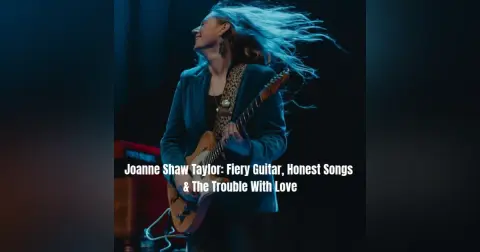
Welcome back to Joanne Shaw Taylor for her third appearance on The Trout Show. The British blues-rock guitarist and singer-songwriter has built a powerful career since being discovered at 16 by Dave Stewart of the Eurythmics. Known for her fiery guitar work, soulful vocals, and emotionally direct songwriting, she has released a string of acclaimed albums and earned multiple Billboard blues chart placements. Her latest release, The Trouble With Love, produced by Kevin Shirley and featuring guests including Joe Bonamassa and Orianthi, digs into the many forms of love with her signature blend of blues, rock, and soul. She’s joining us now to talk about the new album, her songwriting process, and life on the road.
Your comments are appreciated!
Thanks for listening for more information or to listen to other podcasts or watch YouTube videos click on this link >
https://thetroutshow.com/
Joanne Shaw Taylor Interview
[Intro]
Welcome back to Joanne Shaw Taylor for her third appearance on The Trout Show. The British blues rock guitarist and singer songwriter has built a powerful career since being discovered at 16 by Dave Stewart of The Eurythmics. Known for her fiery guitar work, soulful vocals, and emotionally direct songwriting, she has released a string of acclaimed albums and earned multiple Billboard Blues chart placements.
Her latest release, The Trouble With Love, produced by Kevin Shirley and featuring guests including Joe Bonamassa and Ori Anthe, digs into the many forms of love with her signature blend of blues, rock, and soul. She's joining us now to talk about the new album, her songwriting process, and life on the road.
[The Trout]
So people ask me, why do I use David Smith with Edward Jones as our financial advisor? Well, it's very simple. He's been doing it for years.
He's been providing us excellent assistance. He works for the number one client satisfaction company according to J.G. Power this year, 2026. And Edward Jones has been around for 100 years.
Can't be around 100 years if you don't know what you're doing and they really know what they're doing. So pick up the phone and give David Smith a call anywhere in the United States. He'll be glad to listen to what you want to do at 469-372-1587.
469-372-1587. David Smith. I've trusted him with our money for years.
Give him a call, tell him what you want to do, and see what he can do to help you meet your financial possibilities. David Smith with Edward Jones. 469-372-1587.
Give him a call and see what he can do for you and make your life better. I think the thing about it for me is somebody like you that has been doing this for a while, it must be fun to call people up to ask them to come on your records.
[Joanne Shaw Taylor]
Oh, yeah. And it kind of at this point, you know?
[The Trout]
Yeah. I mean, so when you go, I mean, obviously, you and Joe are good friends. I know that because you're on his label.
You've been doing it for a long time. But then, yeah, I saw you at Ortheon, I don't know, too. And then you've worked with, how many times have you, has Kevin done all the producing on most of your albums?
[Joanne Shaw Taylor]
No, he's done a good chunk of them. I think this is the fourth, fourth or fifth. So, yeah, a good chunk.
[The Trout]
And I would assume as an artist like you, once you find somebody like that, that you can work with, you want to keep working with him.
[Joanne Shaw Taylor]
Yeah. You know, I think, you know, not to speak for Joe as well, but obviously he's in a similar boat. He's, I think Kevin does everything of Joe's.
[The Trout]
I think he does a lot.
[Joanne Shaw Taylor]
I mean, it's very beneficial. I mean, I've always said, I think you've got to have a massive level of trust with a producer. You know, at the end of the day, I'm handing over 10 songs.
And, you know, I could give those songs to Kevin, or I could give them to Joe to produce. And I get two very different albums off the same song. You know, it's kind of you have to approach it like a project that you're doing together.
So I think there's got to be a level of trust and comfort. Obviously, I'm at the point with Kevin where he's been a great friend now for 16 years. So I mean, he knows who the songs are about, you know, he, you know, knows why I wrote them.
You know, so there's that part of it. And then just also, you know, I know, I know what he's thinking, I know where he's going, you know, like Death Wish, for example, that was very uptempo. And he added in that, you know, it's going to start slow.
And, you know, he just kind of walked in and said, this is how I want to do it. And it's at the level where I can just trust that and go, okay, well, that's how we're going to try it. And I also know that I can say, Kevin's not working for me, and he's going to go, that's fine.
[The Trout]
You know, you've been doing this a while.
[Joanne Shaw Taylor]
Little bit.
[The Trout]
You know, a little bit. But what I noticed in your new album is the maturity of your songwriting and the maturity of your voice. There seems to be a little bit different.
Was this a more personal project for you, the songs that are in there than anything before?
[Joanne Shaw Taylor]
I think everything's always been quite personal for me, because I think that's the only way I've known how to do it authentically, is to just be yourself. Because, you know, the other option is that you chase trends, you know, well, this is really successful, this guy's doing this or Joe's doing this. And then it's, you know, it's, at the end of the day, I'm trying to make people feel something.
So if I'm not feeling it, you know, I'm not going to. I think the difference is just reaching the age that you're more comfortable in your own skin, more confident, just going, well, if you don't like it, and you don't like me, there's very little I can do about that. You know, essentially, at the end of the day, that is what I am selling is myself.
This is an audio version of my life. So yeah, I think that's the biggest difference of just, you know, that self-awareness and self-comfort, I suppose.
[The Trout]
And I think that's what comes with as we get older, to the point where this is what I do. If you like it, you like it. If you don't like it, you don't like it.
I can't help you.
[Joanne Shaw Taylor]
Yeah, what do you want me to do? You know, and there's actually a song about that on the album. You know, at the end of the day, it's when Nan used to say, just try and be the best person you can be and, you know, hope for the best.
[The Trout]
Well, and I think the thing about online is when you're performing creative, you do what you do, and you hope people like it. You know, you've been doing this a while now that you've got a great fan base. People follow you around.
You've got a great performer out on the stage. You attract excellent performers to come with you. I noticed you had more, you had a lot of, at least a couple of songs with background vocals in it, which I like.
I did look up the studio and I saw the Google thing and I went, must be a church. And then I looked at the website and it's a church. Is that where you recorded it, the one in Nashville?
Because you live in Nashville now, right?
[Joanne Shaw Taylor]
I do. Oh, here he comes. We've got a visitor.
He's decided it's time for his fourth meal of the day. Yeah, so we did it at two because we broke this album up. We recorded the bulk of it at RCA Studios and then we went back in and did another three, four tracks at Ocean Way, which is a church, which, you know, quite a good few studios are, you know, worked in some in London.
I mean, just brilliant acoustics, you know, as well as a certain vibe, I think. I mean, I'm not a religious person at all, but there is something about walking into a sacred space like that. You know, whatever that may be, it doesn't always have to be a church, you know, we've all heard of the crossroads, you know, or down to the Deep South.
It feels, you know, sacred. So, yeah, it's a beautiful studio to record in.
[The Trout]
Does he do... I read this about him. Did you do a lot of live takes where the band plays with you?
Yeah. Okay.
[Joanne Shaw Taylor]
Yeah, so we do... well, we don't do a lot. So we do...
I mean, the band's probably only in for three days. So we do the bulk of the album in three days, I'll play it live. Or sometimes I'll just sing it live if they need because, you know, they're learning quick.
I mean, it's Nashville, they can... you can give them a, you know, three hour rock opera, and they'd have it down in, you know, a couple of minutes. But yeah, my job mainly in those first three days is to, you know, kind of guide the band through.
And then also, when it comes to solos, it's nice to play it live, because then obviously the band feeds off it. You know, if I'm doing something more aggressive, Anton particularly, I love, I've always loved playing with drummers. You know, I like a steady bass player.
[The Trout]
Has Anton played drums for you on this?
[Joanne Shaw Taylor]
Yep. Once we did in Ocean Way, the final three is Greg Morrow. So that'd be you and me, tired of being right and bad boy.
But yeah, great.
[The Trout]
You know how it is. It's great to play in the studio, but it can be... if you can play live like that, that just makes...
I think it just changes everything. You just get the feel for it. Obviously, you're going to have to dub and all that stuff later.
But if you can get a lot of it live, like you said...
[Joanne Shaw Taylor]
Yeah, and again, I mean, growing up with that, you know, I started out as a three piece and loving Stevie Ray and Double Trouble and Jimi Hendrix experience, you know, and for me, the drummer, kind of the paladins, you know, I love a drummer to follow me, you know, and if there's certain things I'm really going for, you know, like Anton on Heavy Soul, that song in particular, that's probably a really good example of it. So, you know, yeah, just definitely up to the dynamic.
[The Trout]
And then you start... I was talking to my wife this morning. My granddaughter is in music theatre and has started her first tour.
How old is she? She's 23. No, no, no, she's 23.
Graduated earlier this year. Wanted to get into theatre management, but she's really kind of a roadie, but she loves it.
[Joanne Shaw Taylor]
Aw, bless her.
[The Trout]
And I can follow her where she is because she's on a big tour for nine months.
[Joanne Shaw Taylor]
See, that's my... Every time I phone my dad, I'm like, sorry, I haven't phoned you. He's like, it's all right.
I'll stalk you on Facebook. I know you're alive. So he just...
It's like you're in Colorado.
[The Trout]
Well, that's what I do. I follow her to kind of give her stuff and like what town, what city you're in or something about it like that. But the bottom line was I was reading your first segment of your tour to my wife.
I said, we're talking about our granddaughter listening. It's like one day after the other.
[Joanne Shaw Taylor]
Yeah, it's a marathon. It's an endurance test for sure.
[The Trout]
And then you had John with the Rackboys opening up for you for some dates. Yeah, I'm not familiar with the other band that's opening up with you. I've got Bywater Call.
I'm not familiar.
[Joanne Shaw Taylor]
Yeah, they've sort of exploded. I believe they're from Canada. Kevin's been working with them.
And I only became aware of them this year. And ever since then, I'm seeing them everywhere. They're in the UK shortly because we just announced a UK tour.
So yeah, seven piece band, I believe from Canada. Husband and wife, I believe. So yeah, they're on, I think they do the first few and then we're out with the boys, which I'm really looking forward to because they're all like, my little brothers at this point.
And years ago, I met them back 10 years ago, and they came and did a show for me. And I stipulated that they could only do the show if they bought me something, a Harry Potter based present. And I think they're slightly scared of me because every time I see them now, there's usually some Harry Potter socks or something.
I'm like, I don't have to keep doing it. But also, thanks.
[The Trout]
Well, but you know, the thing about it is you can guide them. You can at least, they can ask you a question, you go, here's what, you know, if you want my opinion, I could tell you, you know, because you're so good at what you do.
[Joanne Shaw Taylor]
You can try.
[The Trout]
Well, they may not listen to you, but when you started this project, how long ago was it when you started it?
[Joanne Shaw Taylor]
I started this in Christmas, December and Jan 2014-15. So just after Black and Gold had been released. Is that right?
I think so. Yeah. We did it so close.
You know, I was promoting the last album whilst recording this album. So it's become a bit of a blur, to be honest. But yeah, it's been, I think we finished it end of last year.
[The Trout]
And, you know, I've never asked you this, because when I listen to it, how do you typically, when you're writing a song, do you sit down at and start futzing around on your guitar? I mean, how does it kind of come to you? I know it's different for everybody, but how do you get kind of get a good riff going or does it something like that?
Tell me a little bit how your songwriting process goes.
[Joanne Shaw Taylor]
I mean, it kind of depends on the song. You know, it's, I mean, there are times where I sit down and go, OK, I have I have an album coming up. I have to write something for it would be a good idea.
It's all right. He's walking around the kitchen. Here we go.
Yeah, I see. It depends on the song. I mean, it is.
I kind of got into the habit of writing all the music first, and that's kind of how I taught myself to write songs, write all the music, pick a song title, particularly in the early days. And I was, you know, hope this is beneficial to people learning to write. But the big weakness was I found there was a lack of control in my song writing.
So this would be about one thing, the bridge kind of going off on a tangent. And by the time I reached the chorus, we're in a completely different subject matter whatsoever.
[The Trout]
Yeah.
[Joanne Shaw Taylor]
So I found that picking a song title really kind of helped me focus. But that said, it's been so many years now that, you know, it's also an option that something just goes in your head or you hear something that inspires something. So it's again, you don't never have too much control over it, which is frustrating, but also the beautiful thing about songwriting, you know?
[The Trout]
Yeah, because I don't, you know, I'm more into how do you do it, not why you do it, because as a songwriter myself, you can't tell people it just comes. There's no there's no rhyme or reason to it. It's like you can be driving down the street and see a billboard and go, man, that's a cool name for a song.
[Speaker 3]
Yeah.
[The Trout]
You know, I need to say, oh, I'm going to write a song about that. Well, it's kind of funny what you said, because a lot of the stuff I do, I will do a title just like you do, kind of work around that and go, I've got to tell a story now I got the title.
[Joanne Shaw Taylor]
Yeah. And for someone I have really bad attention problems and I'm a big procrastinator. I've always said never understand, never underestimate the power of panic.
You know, I was the kid that was, you know, doing their homework whilst walking to school that day, even though I'd had three. But it just really helps me focus. So I think for me as well, that is a big part of it is I do have a hard time with my attention span.
So to give myself kind of some ground rules does kind of benefit me.
[The Trout]
Did I hear a resonator on one of those songs? Were you playing a resonator or something like that?
[Joanne Shaw Taylor]
I wasn't. There is one on there. I think you're thinking of Hell or High Water.
It would have been Audley, Freed, probably Doug Lancio. Yeah, they don't trust me with the expensive instruments. So it probably wasn't one of those grown ups.
[The Trout]
Do you, when you get involved in a project like that, do you sit down and think you're so you've recorded the basic tracks and you go, does it come to you like, oh, I need to put a choir in here or is that something or I need to add an extra sleight of hand in here? Or is that more up to the producer when you're putting?
[Joanne Shaw Taylor]
Yeah, I leave that to Kevin, to be honest. I think partly because how many jobs do I really want to give myself? I've already written the whole album and performing on it and I'm going to go out and tour and promote it.
If there's a specific thing of like, hey, Kevin, I've got this second riff idea that I didn't put down on the demo that I really want to put in there. There'll be something like that. I tried to be right about you being wrong.
I didn't put on the demo. So I was like, hey, Kevin. But yeah, Kevin's the one.
It's like, hey, you can take a break. I'm going to start organizing the strings. And I'm like, what strings?
Like, all right, I'll be in the coffee shop around the corner, knock yourself out. Yeah, yeah.
[The Trout]
I remember the first album I recorded that he brought in a keyboard player because I was a producer and a friend of mine was a producer. And he sat down, it was a blues song I wrote, and he sat down, he said, we're just going to let him take off. I'm like, what?
So I'm in the control booth, the guy starts playing, and I'm going, he's on a synth, I'm going like, where is this going? And then when he brought it in, he played it back, I went, ah, okay, that's what you heard.
[Joanne Shaw Taylor]
That is something, I mean, going back to trusting your producer, I remember having this conversation, I think it was with Mike Zito, he was struggling with a young artist doing their first album, really trying to control everything. And it is a bit of a shock at first of like, hey, you write these songs and you sit with them and you get them in your head, and then to hear them be changed is a very protective thing. So again, you have to kind of relinquish some of that control, else you may as well just produce it yourself.
And again, if you've got a producer, you reserve the right to say, hey, this is not for me. At the end of the day, Kevin knows this is my album that I've got to be happy with. He's going to spend two weeks on it, I'm going to spend two years on it.
[The Trout]
Right. Well, it goes back to what you said earlier, there's a young artist that I talked to, they struggle to find a producer they can work with because they want to come in and change the people. They want to change, oh, you need to change this, you need to change that.
And it's like, no, I don't want to change that. So go back to what I said earlier, you've worked with him so while now that you kind of know each other, you know what you do. And that makes a whole lot difference.
And I would think it also makes it more fun.
[Joanne Shaw Taylor]
Yeah, I mean, I mean, Kevin's one of my closest friends, you know, I'm actually going to dinner with him tonight, if John lets me. But yeah, to have that kind of, you know, again, he knows what the songs are about, he knew who I've written about. I mean, at this point, I don't have many friends who were able to meet my mom because she's been gone so long and Kevin did, you know, Kevin and Joe have.
So, you know, there's a good foundation there.
[The Trout]
Let's change the subject real quick. Rig, are you changing anything or still? Tell me a little about your rig now that you're out with, you're going to go out on this tour with.
[Joanne Shaw Taylor]
I seem to be taking more and more things away. I think at some point I'm just going to be left with a guitar and a plectrum. Sorry, pick.
Yeah, to speak the lingo. Yeah, bassman, Fender bassman, 1962 and the 1963, a tube screamer and a reverb pedal because I don't want to carry around a reverb tank. Three guitars, not including an acoustic.
You know, that's enough for me.
[The Trout]
So when you're on the stage, let me ask you this. So when you're playing, you're doing some rhythm and then all of a sudden you're going to boost up to go to the lead. What do you do?
Use the tube screen or what? How do you do to boost yourself?
[Joanne Shaw Taylor]
I have two tube screamers on the board. So depending on the song, so if the rhythm part's clean, I'm just straight into the amp and then I'll hit the tube screamer for a boost for the solo. If it's like a rock riff, the tube screamer will be on for the rhythm part.
And then there's a second tube screamer with no distortion, just volume. Most people do amp switching. I don't.
It's just another pedal that you've got to hit. And, you know, my hand and my not so weird mouth and mind are all a bit busy.
[The Trout]
You've been playing with the bassman. That's your favorite thing. You've been doing that for a long time, haven't you?
[Joanne Shaw Taylor]
Yeah. And I don't know if it was a poster on my wall. I was a massive Johnny Lang fan and we had an advertisement for Vibra Kink and it was him with the Tweed amp.
And I think just the Tweed color amp. And then my dad had a reissue Fender Bassman. So it's kind of what I started on.
And I think it's just I am a sort of person, if it's not broke, why fix it? You know, it's given me the same time I've had since I was 14. So and nobody's complained too much yet.
[The Trout]
So you don't spend a lot of time changing. Do most of your guitars are they stocked or you change a lot of stuff on them or not?
[Joanne Shaw Taylor]
Depends on the guitar. I mean, Junior's still my main guitar and I use him for the bulk of the set. So any guitar I have or any guitar change I do is for a very specific reason.
So it might be because I need a capo and a rhythm part, you know.
[The Trout]
So I mean, the physical part of the guitar, do you like changing the pickups, the neck or a lot of people looking? Do you keep standard stock when you go up?
[Joanne Shaw Taylor]
So for instance, I got a backup at the moment I use for a couple of songs with capo so that I bought stock American Tele. I just found I love Rosewood Neck and my guitar tech did change the hardware and change the pickups, which to be honest, I think he mostly did because he's so bored being my guitar tech because hardly anything to do that. It was like, yeah, knock yourself out.
And he's like, can I age it and make it look old? I'm like, you knock yourself out. Have fun with your boots.
[The Trout]
All right. I got three minutes, but I'm going to cut off before that. Tell me what you want.
What are people what's the message you want to send the people to your album? Tell me what the message is on your new product, your new project.
[Joanne Shaw Taylor]
That's always a hard question because I feel like I shouldn't be dictating to people what their experience should be. You know, it's at the end of the day, I did this because I wanted to and I really love it. And it's my means of expression and coping with everything we all go through in life, the good and the bad and the ugly.
So I don't I think if I have a want, it's just that I know, I know they enjoy it, really. I hope they get something out of it. You know, at the end of the day, I hopefully have created something that someone else will get pleasure out of.
That's the main thing. Hang on. I got to come up.
[The Trout]
All right. Thank you. It's good to see you, Hank.
[Joanne Shaw Taylor]
He's a needy boy.
[The Trout]
Yeah, I've seen enough of that. He just came in after a while ago. He said, no, I'm not going to stay in there.
Well, all I can tell you is I've always when John asked me, I said, I've always enjoyed listening to you. I always enjoy talking to you. Thank you.
It's a pleasure.
[Joanne Shaw Taylor]
Always your name on the list today.
[The Trout]
And all I can say is have a great tour. I hope the album does well. I have my Joe shirt on for you today.
Hey, when you put them on sale for three for 25 bucks, I'm in. We got to get you a Hank t-shirt. Do you have Hank t-shirts?
Yeah. Okay. Can I get them online?
[Joanne Shaw Taylor]
What's the story? It's a float.
[The Trout]
I got to have a Hank shirt then. We'll take care of that. All right.
And I want to tell you, thanks again. I appreciate you very much. I think you're a wonderful performer.
I like you as a person too. Maybe one day I'll actually get to see you in person.
[Joanne Shaw Taylor]
Maybe you'll get off your butt and come give me a hug at the show.
[The Trout]
Well, if you're ever in Dallas, we're just a little bitty town to go touring in.
[Joanne Shaw Taylor]
Yeah. I was hoping next year. We haven't done Texas for a while.
[The Trout]
No, you haven't.
[Joanne Shaw Taylor]
No. I'll kick the agent up the butt. I'll have a word.
[The Trout]
Have a great tour. Thank you very much for your time and have a successful release. All right.
[Joanne Shaw Taylor]
All right. Thank you, sweetheart.
[The Trout]
You take care. Bye. Okay.
See you. Bye-bye. Well, that's it for this episode of The Drought Show.
Thanks so much for stopping by and listening to my interview with Joanne Shaw Taylor. Yes, it was the third time she was on the show. You know why?
Because she's really good at what she does. She's a great performer, writes great music, and she's a very nice person to interview. I really enjoyed it.
I hope everybody picks up her new album, or if you get a chance to go see her, you can check out her website at Joanne Shaw Taylor, alloneword.com, and you can find everything you need to know about her. Thanks again, Joanne. Appreciate you.
Good luck with your tour and your album. Special shout-out to the guy that keeps the lights on here, Mr. David Smith, David Jones. Thank you, David, for coming on and supporting the show for so many years.
We appreciate it very, very much. And check him out if you have some financial questions you want to have answers to. For more information about The Drought Show, all you got to do is go to my website, thedroughtshow.com.
Everything is there, all the podcasts, all the interviews I've done, my music, you know, yada, yada, yada, and so forth. Got a lot of great interviews coming up, as always, so stick around, and thank you for supporting the show. It's the first time.
Thanks for coming here. Thank you for coming back. Thanks very much for returning.
From me to you, remember what I always say, it's only rock and roll, but I love it. See ya.
Transcribed by TurboScribe. Go Unlimited to remove this message.