
Nili Brosh - a New Generation of Phenomenal Guitarists

 Apple Podcasts
 Spotify
 Castro
 RSS Feed
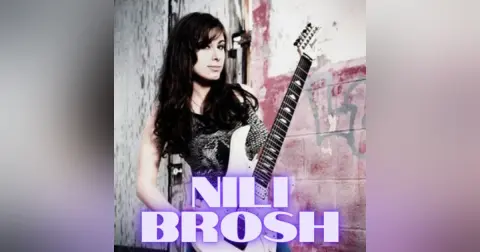
 Nili Brosh is part of a new generation of guitarists. Both a solo artist and a sidewoman, Nili currently plays with Danny Elfman, Cirque du Soleil, Dethklok, as well as her original band.
Born in Israel, raised in Massachusetts, and educated at Berklee College of Music, Nili has performed with Steve Vai, Paul Gilbert, Tony MacAlpine, Andy Timmons, Guthrie Govan/The Aristocrats, Stu Hamm, Jennifer Batten, Gretchen Menn, DragonForce, Jeff Loomis, Alphonso Johnson, and The Iron Maidens. Nili has also released three solo albums (Through The Looking Glass, 2010, A Matter of Perception, 2014, and Spectrum, 2019), the material from which she performs and gives clinics on.
Additionally, Nili has written a lesson column for Premier Guitar magazine, released several courses with JTC Guitar, and recorded guitars on Danny Elfman’s 2021 and 2022 releases “Big Mess”, “Bigger. Messier.”
In this exclusive interview with The Trout, Nili talks about her career and musical style and where her path to musical success.
https://www.nilibrosh.com/
https://www.thetroutshow.com/
Thanks for listening for more information or to listen to other podcasts or watch YouTube videos click on this link >
https://thetroutshow.com/

Season 03 - Episode 17 – Nili Brosh | Transcription
Sponsored By: Are you professional in the music industry, and frustrated with all the legal issues that you must deal with all the time? Well, let us help you. At the Fein Law firm, we've helped people just like you, entertainers, weave their way through the legal issues that you face. Eric Fein has over 10 years of experience working with entertainers, just like you from copyrights to royalty agreements, venue agreements, anything that's involved with your business. Eric Fein can help you. You can easily reach Eric at 214-522-9596 or find us on the internet at ericfeinlaw.net that's F-E-I-N. Eric Fein ready to help you with anything you may face. Get out there and do your music thing and leave the legal issues to us. Eric Fein Law 214-522-9596. Follow us today, Eric Fein law.
PODCAST INTRO (Trout): Hey everybody it’s Trout and I hope you're having a great day and welcome to The Trout Show. You know I'm always on the lookout for individual guitars that can really play phenomenally good, by listening some difficult music and then playing it note for note, but at the same time being able to maintain their own individuality when it comes to writing their own music. Well, I was lucky I found a person like that. Her name is Nili Brosh. She's played with some great guitarist of the arts Steve, Jennifer Batten. She's played music with Danny Elfman. And she's also performed with Cirque du Soleil in Vegas. But what separates her is the fact that not only she's a Berkeley music school graduate, but she can play those difficult pieces that I could never even think about starting up. But also does her own music, records her own songs that are on style and I liked that. And I think you'll like listen to her story about how she got where she is, how she maintains her individuality. And how she in a group where it's always mostly men, isn't is another great woman that's performing in a difficult business to get in if you're a woman. So I'm glad she sat down and talked to me about her life and I think you'll like it. And I think you'll enjoy listening to Nili Brosh. So sit back and listen to the guitar stylings of a phenomenally great guitarist, and here is Nili Brosh. That's next on The Trout Show. I want to ask you questions that as a guitarist myself, I'm always intrigued by a couple of things. And one of them, I know you started playing when you were young? When did you realize you had the capability of playing so good? I know you went to Berkeley and all that stuff. But when did you realize that, I can emulate this song. I can hear and start playing it. When did that start happening to you as far as saying, I can do this?
Nili Brosh: I feel there's layers of what I can do. I think probably around high school, later high school. I started feeling like I had the facility to play whatever I was hearing because the practice of finding whatever I was hearing on the guitar was something that was always very natural to me that to me was the way I would have learned any song anyway, so that was my natural way of working on it. But I wasn't able to play everything I was hearing until later on when I put some other things together and spent a lot of time doing that practice. So, maybe 16, 17.
Trout: And then you started realizing, did you realize at that point because people that you knew or playing with you or whatever was going on, did you realize that you were so much better than them?
Nili Brosh: First of all, it really wasn't like that. But also, the toughest thing for me at that time, I felt I like the music that I couldn't find peers of my age that would want to play it with me. It's more of a genre thing where the kids in the school that I went to would want to play indie music or something else. And I was the shredder and they weren't really interested in that, so it was more of that thing.
Trout: And then as you got older, and you went to school, you graduated from high school, and then you went to Berkeley in California. And I have never been one that sat down. I've got to better as I've got older. But I mean to sit down and listen to a song go, I can do it. Now, I used to go what key are in, around 14, futz around on the guitar and find the key, but one of the things is, and do you still do online lessons and stuff like that?
Nili Brosh: I have very little time for that.
Trout: But what he said was, I wanted to see if you think this because obviously you had the skill set you were born with it, which you have. Did you believe that going to the school Berkeley helped you understand how songs are put together? When you listen to it as far as the components of the song, in other words, you go this is going to be a minor, they're going to do this thing over here. Because the way music is written, did that help you understand it better?
Nili Brosh: I don't know if that was what I needed from Berkeley because I knew enough theory by the time I went to Berkeley to do my own analysis for most things. Maybe some more complex stuff harmonically, it helped with but in general, that was something that I was able to put together. But there's a lot of other stuff that came from Berkeley education, obviously.
Trout: Well, I never took lessons for a couple years ago, many decades ago. And then the guy said, I never did understand. He told my mom and dad, I can't teach him anymore. So I don't know if I really sucked, or I was really good.
Nili Brosh: Maybe he just had a certain threshold of what he knew.
Trout: I think so. And, unfortunately, I never got to thank that guy. I thought about him. I never forgot his name. It was one of the things you never forget. And then I realized one day, I need to look them up. Of course, he passed away years ago. So it's like a miss, tell him hey, this is what I do now. And he go like did I do that? Yes, you did. But as you grew as an artist, and you got to the theory, because I know there's a point for you, I'm sure. And I think what everybody is, you write your own stuff. But you also are incredibly good. Look at what you've done in the past, where you had Cirque du Soleil and all this stuff that you've been in where you have to play note for note songs that you heard. I'm just being quite honest with you and telling you the truth. You could probably make an extremely good living doing that. Just playing music for others. Like somebody calls. Hey, can you emulate this? Or can you do that? But then you got your own style on top of that, which drives a different direction. I would assume also picking up the ability, to pick up everybody else's style, which we all do is probably helped you with your own style. Because you probably listen to somebody and go, I never thought about that. And so when you perform now, are you bringing the band with you? Or they provide the people they help play you're doing?
Nili Brosh: So what I'm doing, which is the same thing what I did last year is there's a house band that will play, a few of my friends with me, and then I will play the rest of my set to a backing track. But it depends on the situation. There's a lot of times where I will play my music with my band, or, I've done it so many different configurations.
Trout: Are you working on something now? Most musicians I talked to they're constantly working on new album.
Nili Brosh: Obviously, you're always working on your next album. And it's just keeps getting interrupted by everything else. I actually have two new singles coming out on next month, one on May 9, and the other on May 10, which is actually on purpose because they're meant to be listened to in sequence. So the first one comes out on the ninth and then second one. First one called song for hope. Second one lavender mountains.
Trout: I think I did see that. I think it was on YouTube or something.
Nili Brosh: There's going to be the links are up for the premieres on the ninth and tenth. And the lavendar has a music video as well. So that's going to be on May 10th.
Trout: So when people come up to you and don't know you, and they say, what kind of music do you play? What do you tell them? Don't just say I play guitar? What do you say?
Nili Brosh: I say I play everything. Because I feel like by now, I've been hired to do so many different things. That's a clear definition. But then if they ask about my music, or what, I say primarily play rock music or I say instrumental rock, or sometimes I say prog or depends on gauge, the person's level of understanding of what each of those things mean, as you start putting out words, if you're going to get a blank stare past rock, then stay there. And then if somebody asks for an example, of someone I would have heard of, then you say, Eddie Van Halen. I think that's what has become of those answers. Usually, people don’t, so you would hope.
Trout: Well, in the genre, it's always Stevie Ray.
Nili Brosh: Well, sure. I love Stevie Ray Vaughan, don't get me wrong.
Trout: its two completely different things. And both of them were incredibly great players, but they just completely different. And when you write some songs, I have few instrumentals, mostly mine have words, and lyrics. Do you sit down and do it, or I'm always curious about everybody else does their stuff? Do you just get an idea or start futzing around your guitar and go I got a little melody here thing going on? How's it work for you.
Nili Brosh: So usually, ideally, I hear a melody or an idea in my head, and I jot it down in my voice memos, usually singing it, is usually a good test for how memorable that melody is going to be probably. And that usually comes with a set of notes for what I think, the arrangement should be etc, I hear a harmony here. Or, I tried to take as many notes as what I'm hearing in my head, and just to jot it down, and then when I'm ready to really flesh it out and work on it, then I start demoing it on logic and I'm putting together the rest of the picture and then it goes to the whoever's going to play on it.
Trout: And I think what was interesting to me was, what's your favorite guitar now? I know you endorse some.
Nili Brosh: It's an Ibanez.
Trout: Do you always play mostly solo body stuff?
Nili Brosh: Pretty much, yes.
Trout: Are you still doing the Head Rush thing?
Nili Brosh: I was always doing it part time, for me it's all based on the gig and what I need to be doing, there little MX five has served as the perfect fly rig just because of its size. So now in the last couple of years I have traveled so much with it that it's just a smaller one and it is the tiny one that fits in your backpack. It's really tiny. It's incredible and everywhere I go with that. No one can believe that I got all my sounds from that. This is so powerful. So it's always been a solution to so many problems. And if I'm in a situation where I can bring an amp that I want to play, and that makes sense, and I'm not carrying it, or again, it makes sense in some reason, then I would rather have that, but it's just not always going to be realistic.
Trout: I looked at getting when I came out, I was in a band, and we broke up at COVID. And I was going to get the big one. Because I used to have a DigiTech rack unit, and it had a floor thing. And I could do as many, I think it was four or five effects at the same time. But what I really liked about it was I could program every song or the set list in, so I just push the button and here's the next song. And then everybody went to these pedals on the floor where they have 40 of them on the floor, and I'm gone like, Okay, I don't want all that stuff, because I was like, it's not a lot of effects people. There's certain things that people use. I'm always been a delay guy, and a little bit distortion, and then again, the blues world, they don't use much anything, it's all pretty clean. So when you write a song, and this is because you're such a great songwriter, and great guitarist, do you think about, this is the effect you want to use, or you start thinking, I want to put the delay here, or how's that work for you when you do something?
Nili Brosh: I think about it as the instrumentation first. So first is the song, do I really hear that guitar is the lead vocalist to begin with? Sometimes it's a different instrument. I have songs on my record, one is played by an accordion and a violin. So it's not always me. But even when it is, it doesn't mean that I'm hearing a straight guitar tone, like you were saying, although most of the time it is. So again, I'm asking myself like what do I imagine as the lead instrument or vibe of that tone? What am I trying to say with my guitar? So whether that's I'm with you, I like delay, and I'm pretty much a purist when it comes to tone, I just like warm distortion, a little bit of delay, like you said, to keep it open, but yes I tried to let the melody speak for themselves. And when it needs something a little bit more, a little bit of a different voice. Then I asked myself what that might be in towards whatever that is.
Trout: When you play, what’s your amp is of choice?
Nili Brosh: Right now, I've been playing the Mesa TC 100 for a few years now. And it's been awesome.
Trout: And that a tube head or not?
Nili Brosh: Yes and that's going to be featured on DC singles as well. I think they're the first yet. They're the first music I'm releasing recorded with that amp.
Trout: Let's talk about the songs that you have coming out, because there are come out right after the same time, tell me about both of them.
Nili Brosh: So the first one song for Hope was literally what it's called, during the pandemic, just represents the quiet need for optimism that I think we all felt a few years ago. And then that meant, not really transition. But the next thing that's supposed to come along in the story is lavender mountains, which is more of an uplifting, not to say ending but it's just like the whole thing, we went through the journey and we've ended up in a little bit more of a triumphant place. And then lavender mountains is inspired by the mountains of Las Vegas that surround me, it's where I live and having come from Israel, I just always felt like the deserts my natural habitat ever since I got here, It was reminded me of how I felt as a kid in some way that I couldn't explain. And I always get a lot of inspiration from the nature out here and the mountains and how they look purple and the sunlight and everything's, literally the lavender mountains and that's visually represented in the music video as well. So it's all meant to go together.
Trout: Look forward to hearing it and seeing it. Are you in the videos?
Nili Brosh: Yes, there's one. It's just for lavender mountains. The other one doesn't have a video. But yes, I am in it.
Trout: So let's talk about your roots, so to speak? Do you go back to your home country? Or you ever go back or have desire to go back?
Nili Brosh: I do. I haven't in a long time. Only because, well, I can't feel find a really good pocket. I've been living on the west coast for so many years now. It's considerably longer than it is from the East Coast. When I was younger, and my grandparents were still around, I felt like there was more of a reason to have more of an annual visit. But now that's all in my past. So it's as much as I love it. And there's so many places I want to visit as a grown up and do a certain trip. Again, when do you prioritize that?
Trout: When did you realize that you wanted to do what you're doing for a living? What did it kick in? And you say, I want to people are going to pay me to do this? How cool is that?
Nili Brosh: I don't think I ever really thought that people were going to pay me to do this. I think when when you go to Berkeley, I don't know if it's Berkeley, or if it's my family, or my upbringing, or whatever. But I really, however, was taught to go in with the mentality of like, if I'm one of the few lucky ones that ever got, like, a paying gig for anything, I was like, preparing for a life of falling back on something else. So I don't know, what would have happened if I'd had a different mindset. But I was definitely like surprised by the prospect of any of it.
Trout: You know, what I find in the most the people that I talk to, that are very talented like you, there's always one part of this that I always have to explain to them. And that is, this is the cool part. You don't suck. You're really good at what you do.
Nili Brosh: But that doesn't really get even if you are, it doesn't guarantee you anything.
Trout: I understand this breaks too, because, look, I've interviewed people that I know will never make it. And some of them I hope they do, because they're really good. But it's just sometimes the luck of the draw. For everybody it's different.
Nili Brosh: And for today's world is different too, it just means different things. And was there ever one definition? I don't know, maybe.
Trout: I've always felt that if pay with your professional, it pays for the stuff that you need, like food, clothing and shelter.If you're making enough money to do that, and then you're doing okay. And then if you make more than that, and you keep going, I can buy a car then you really get to the next level. And the other part I think people don't realize too, is it's a lot of work?
Nili Brosh: Yes. It's so much work.
Trout: You're not digging ditches, but you have a lot of work to do.
Nili Brosh: Yes, a lot of work in a lot of different areas, as well.
Trout: So what kind of things attract you? Or what kind of people come to you and say, Can you do this? Can you do that? You have done a lot already?
Nili Brosh: I've done a lot of different gigs. And I continue to get calls for different things but I've done corporate gigs. And I've done random weddings because a bride asked for a Top Gun theme, and I've obviously done the gigs that people know me for and sessions that maybe people wouldn't have known about and things like that. So I feel like I've really done all over the stuff from all over the gamut.
Trout: But I think that's a good thing. I interviewed a 10 year old. There's already a great guitar player out of California. And I asked him, about a couple months ago. I said, “What is it you want to do?” A lot of people, young people, all want to play in front of 10,000 people and have people screaming, can I have autograph and all that? He was like I just want to play as many instruments I can.
Nili Brosh: Awesome. That's an amazing vision 10 year old to have. That's great.
Trout: And I said to him, I said, Well, the good news about you is when you do that, just like you, people can call you and go hey, can you do this? Because they know you can do it. Tell me what you want to do. What's your favorite thing to do? You do a lot of things now but if you could wave a one and say this is what I want to do? What would you do? You don't really tour a lot, do you or not?
Nili Brosh: I do, It just depends on which acts that I'm in, or going on tour with, for example, I'm doing a tour with death clock this fall, I'm involved in, it's not my band. But, for me, my ideal was always I wanted to split the side work with my own gigs, which is what I’m doing, so it's hard to say. But I'm always going to get an event split because schedules don't work like that even under the greatest of circumstances. So again, that's how it turned into such a juggling act as I'm just trying to take it as it comes and not burnout, I guess.
Trout: Well, you're fortunate that you're that well known already. You have that capability of doing that.
Nili Brosh: I don't know that. I've been at this for a while. And it feels like it's been a long road. And it really is a marathon and not a sprint.
Trout: I think about people like Eric Clapton, they are 40 years older than you. He is still doing it.
Nili Brosh: Well, I'll be lucky to be doing that when I'm older.
Trout: Just your fingers will slow down, that's all. And the music I think is interesting, because the more changes, the more stays to say. What do you got ahead of you this year? Do you already know what you got ahead of you? Or you just take it as it comes to?
Nili Brosh: I have a band with Jeff Clark, and a lot of Cirque shows coming up for the rest of this year as well. I got a few solo shows as well. Obviously, Dallas being one of them. And some other stuff that will be announced as we go along.
Trout: Well, people want to come to you to say to come see me in Vegas.
Nili Brosh: No, actually people now that I'm part time, and I'm not there all the time, people now just ask like, are you doing anything in Vegas this week. Are you doing anything this week, this week, and I'm just like, I don't know. I wait for the calls. So it’s on call, which is great. Because you have a regular rotation, I do an average of four shows a month, if I'm home, if I'm not, it's cool. But then if they need me to sub in for the girl who's full time, Sharon, then they'll call me same day and asked me if I'm around. And then I can say no, if I'm not available, or I come in and I help out last minute. So it just depends on what I'm doing. But it's a nice thing to have every once in a while, obviously. But also just because it's nice to have one thing that I've done so many times, I don't have to think about it, there's no prep, or there's no guitaristic mental or musical prep of any kind, it's like very much on autopilot. It's physically way more taxing than all the other gigs. So it's a very different situation. But it's so consistent in every way. Schedule wise too. So it's nice to have one more anchor and a storm.
Trout: How did you get that gig? Did you just try out for like everybody else or what do you do?
Nili Brosh: That show has a particular role. It's really, supposed to be Jennifer batten. And they would never say it like that, but that's really what it is. And so, when they were creating this show over 10 years ago, now, they were about to have a 10 year anniversary, but they did like an open casting call for that, because I think they realized that it was a very specific thing to find. So the original flyer was sent to me by every single person ever. And then I didn't get it the first time and I came in several years later, but I got close and I had developed a relationship with them. And I also realized that they as well as some other comparable shows, or companies, they have casting websites, and they're public about that stuff. So if you're an acrobat or a gymnast or whatever, you look it up and they're like this show is looking for flute player, or whatever. So those things are out there. I didn't know that before this one but sometimes these things really are public and people don't think about it. But they will tell you the list of qualifications that you would need and it's just like any job.
Trout: Do they tell you when you were trying out you had to wear an outfit, or you realized?
Nili Brosh: I think I knew that just because the way they were promoting the whole thing, it was very clear that you're going to be a character.
Trout: Going back to when you were a kid, growing up in Israel, were you different than everybody else, or did everybody else play music? Did your Brother play too?
Nili Brosh: Yes, so that's how I got into it as my brother and my older brothers and just my family in general was listening to older music around the house than when I was growing up in the 90s. So I was exposed to a lot of different things. I definitely was the odd one out but at that time, I always loved music and that was a part of it. But when I was a kid it was more for being like a sports type of tomboy and in Israel sports was not a girl's thing, it wasn't like every girl played soccer and far from it. So i was mostly made fun for that if anything.
Trout: Thank you very much. I wish you the best. I'll keep watching. I can't wait to see your new videos.
Nili Brosh: Thanks so much.
Trout: Thanks for your time. Take care of yourself. I’ll see you. Bye, bye.
Nili Brosh: Thank you.
[Music 00:31:46 – 00:34:54]
PODCAST OUTRO (Trout): Well that's it for this episode of The Trout Show. Thank you so much for listening and very special thank you to Nili Brosh for coming on and visiting with us. For more information about Nili, you can visit her at her website at N-I-L-I B-R-O-S-H, nilibrosh.com. Very special shout out to our supporters the Fein Law firm today. Thank you, Eric Fein and the Law Firm. And as always people you know what I say, if you want more information about The Trout Show, visit us at our website. This is available on podcast and YouTube. Our website is www.thetroutshow.com. Until next time, people remember, it's only “Rock and Roll”.